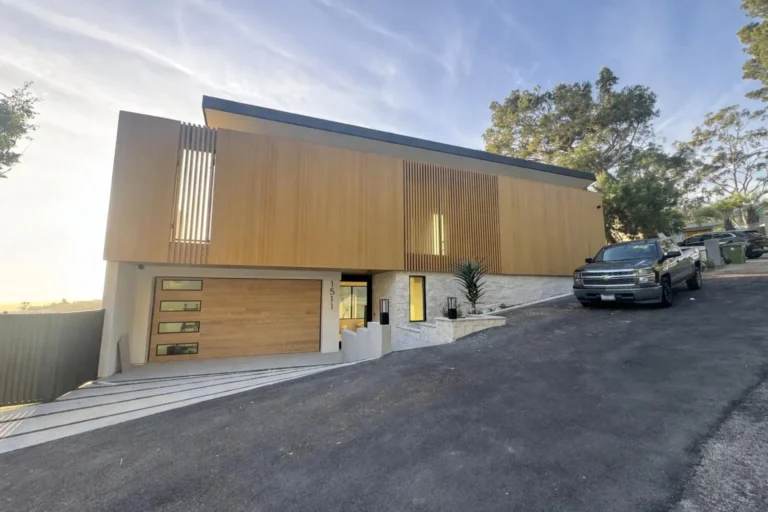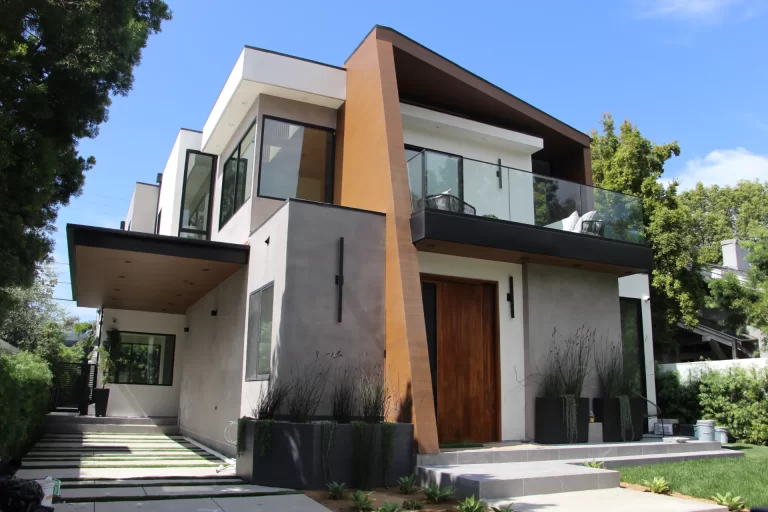

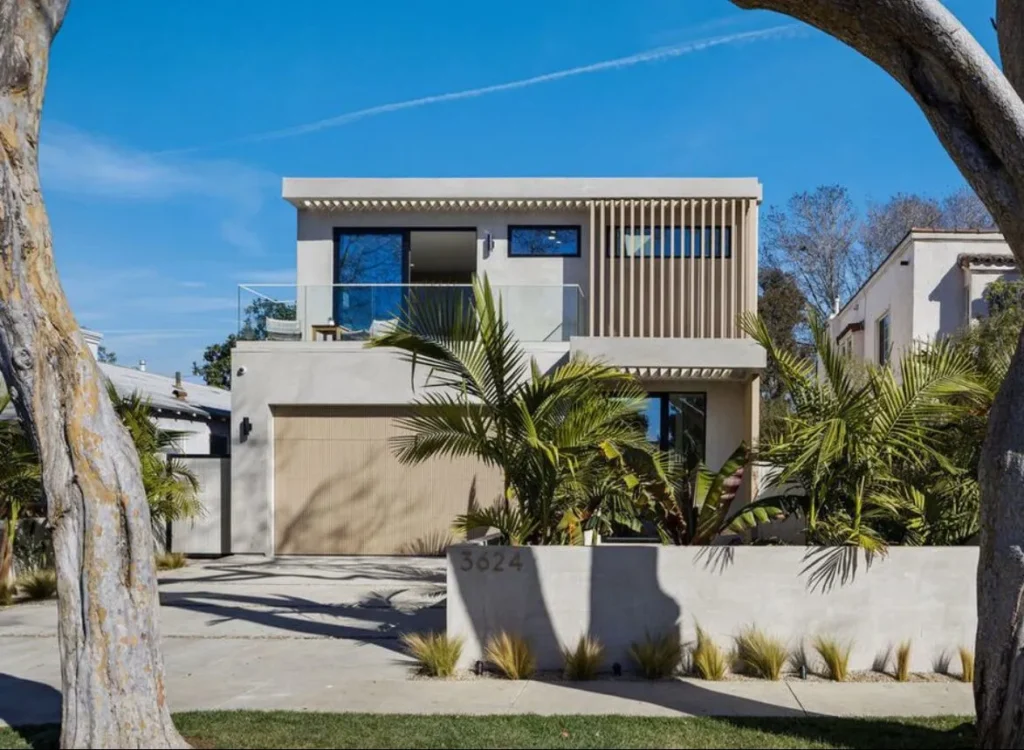
After the Palisades and Eaton fires destroyed more than 16,000 structures in January 2025, plan reviewers across Los Angeles County started flagging the same sheet of California Building Code at almost every counter visit: Chapter 7A, Materials and Construction Methods for Exterior Wildfire Exposure. WUI Chapter 7A cladding is no longer a niche concern for a handful of canyon properties. It’s the first technical question on any rebuild, ADU, or new single-family build in a designated fire hazard zone, and the answer the AHJ wants in writing.
For architects, contractors, and homeowners working on California rebuilds, the practical question is narrower than “is aluminum fire resistant?” (We covered that one in is aluminum siding fire resistant.) The question this article tackles: what does the WUI Chapter 7A cladding pathway actually require, what documentation does the AHJ want to see, and which aluminum cladding specs meet it cleanly enough to sail through plan check?
The Quick Answer
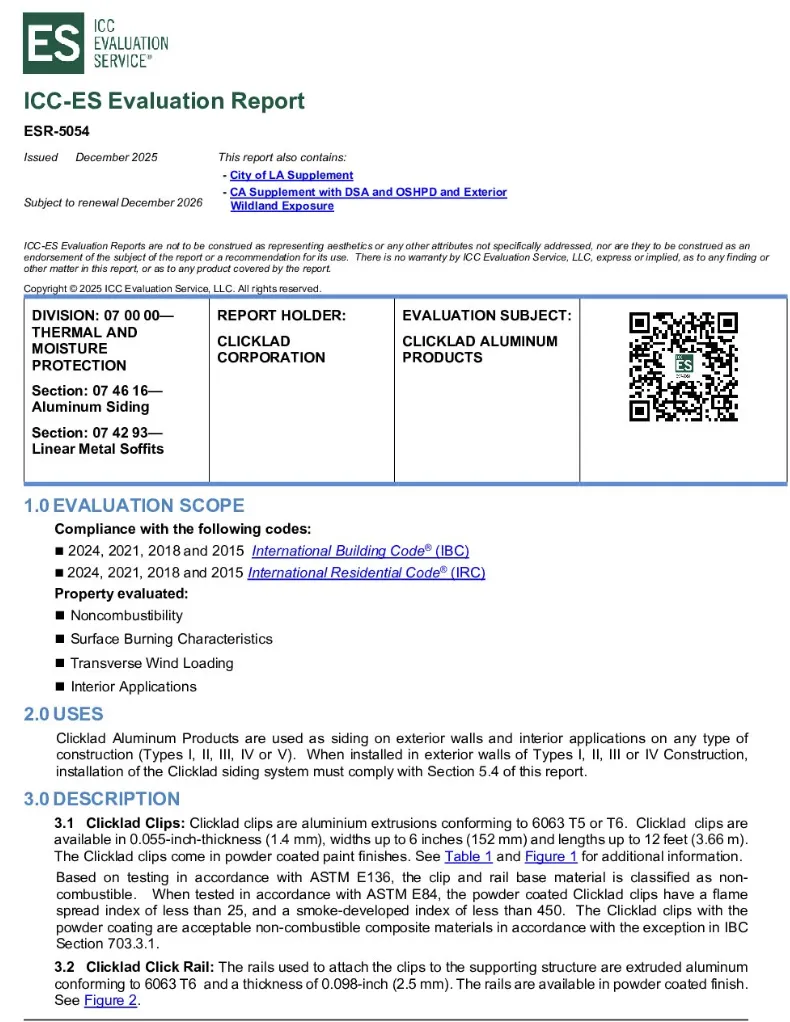
California Building Code Chapter 7A requires exterior wall coverings in Wildland-Urban Interface Fire Areas to be one of: noncombustible material, ignition-resistant material, heavy-timber, log-wall construction, or an assembly meeting the SFM 12-7A-1 ten-minute direct-flame test. Aluminum cladding qualifies under the noncombustible material pathway, the strongest and easiest-to-document of the five. A compliant spec needs an ICC-ES evaluation report citing ASTM E136 noncombustibility plus an Office of the State Fire Marshal (OSFM) WUI Building Materials Listing. Clicklad’s system carries both: ICC-ES ESR-5054 and an active OSFM listing under the Building Materials Listing program administered by CAL FIRE.
The rest of this article walks through what each piece means and what an architect or contractor should hand to a plans examiner.

What Counts as a WUI Zone in California
Chapter 7A applies wherever the building falls inside a Wildland-Urban Interface Fire Area. Three overlapping designations trigger it:
- State Responsibility Areas (SRA) with a Moderate, High, or Very High Fire Hazard Severity Zone (FHSZ) classification, mapped by CAL FIRE
- Local Responsibility Areas (LRA) designated as Very High FHSZ by the local jurisdiction
- WUI Fire Areas designated by the local AHJ for hazard reasons not captured in the SRA/LRA maps
The CAL FIRE FHSZ maps at the CAL FIRE hazard maps portal are the authoritative source. CAL FIRE released a major SRA map update in 2024 and is rolling out updated LRA maps through 2025 and 2026. Several Palisades and Altadena neighborhoods burned in January 2025 now sit inside Very High FHSZ boundaries that didn’t appear on the older maps, which means many rebuild projects fall under Chapter 7A even when the pre-fire structure wasn’t built to it.
If a project sits inside any of those three designations, Chapter 7A applies. No “close to” exemption, no grandfathering for a rebuild on the same lot.
What Chapter 7A Actually Requires for Exterior Wall Covering
The exterior wall covering provisions live in CBC Section 707A and CRC Section R337.7 (residential). The language is specific: the exterior wall covering shall comply with one of the following:
- Noncombustible material (tested to ASTM E136)
- Ignition-resistant material as defined by SFM Standard 12-7A-5
- Heavy-timber exterior wall assembly
- Log-wall construction assembly
- Exterior wall covering assembly tested in accordance with SFM Standard 12-7A-1 (a ten-minute direct flame and one-minute radiant heat exposure test)
Each pathway carries different documentation burdens. The noncombustible pathway is simplest: if the material passes ASTM E136, no further fire test is required for that wall section. The ignition-resistant pathway requires periodic re-listing and finish-specific qualification. The SFM 12-7A-1 pathway requires assembly-level testing of cladding plus substrate and is typically used for engineered wood or composite assemblies that can’t pass E136 outright.
For a specifier, the noncombustible pathway is almost always the path of least resistance. It collapses three questions into one: is the material itself noncombustible? If yes, the rest of Chapter 7A’s exterior wall provisions become much shorter conversations with the AHJ.
Ignition-Resistant vs. Noncombustible: The Distinction That Decides Your Permit
The two terms get used interchangeably in marketing copy. In code, they’re not the same thing.
| Property | Noncombustible material | Ignition-resistant material |
|---|---|---|
| Defining standard | ASTM E136 (vertical tube furnace, 750°C) | SFM Standard 12-7A-5 (extended ASTM E84 test, 30-minute exposure) |
| What it measures | Whether the base material sustains combustion at all | How slowly flame spreads across the surface under extended exposure |
| Test pass criterion | Material does not sustain flame and weight loss limits | Flame spread index of 25 or less, no progressive combustion over 30 minutes |
| Common qualifying materials | Aluminum, steel, brick, concrete, fiber cement, gypsum | Treated wood, engineered wood with intumescent coating, some composites |
| Re-listing requirement | None for the base material | Often required on a multi-year cycle for finishes and coatings |
| Documentation effort | Single ICC-ES report citing E136 | E84 extended test, OSFM listing, and finish certification |
| Strength of Chapter 7A pathway | Strongest, no assembly test needed | Conditional, finish-dependent, re-cert required |
Aluminum qualifies as noncombustible under ASTM E136 without finish-dependent caveats. The metal itself doesn’t burn. The powder-coated finish is tested separately under ASTM E84 for surface burning characteristics (Clicklad’s panels score Class A: flame spread index less than 25, smoke-developed index less than 450), but the noncombustibility designation rests on the metal, not the coating.
An ignition-resistant cedar product is still a wood product. The treatment slows ignition, but the base material is combustible. If the treatment ages out or the coating wears, the wall is no longer compliant. That re-certification risk is one reason architects on California rebuilds increasingly default to noncombustible specs from the outset.
The Documentation a WUI Chapter 7A Cladding Spec Actually Needs
A plan reviewer at any LA County, Ventura County, or San Diego County permit desk wants three things attached to the exterior wall covering callout:
- A current ICC-ES evaluation report (or equivalent IAPMO UES, QAI, or other accredited evaluation) citing the relevant code editions and the ASTM E136 noncombustibility finding
- An Office of the State Fire Marshal Building Materials Listing confirming the product is on the CAL FIRE list of approved WUI exterior materials
- Manufacturer installation instructions matching what’s drawn on the elevations and wall sections
The OSFM Building Materials Listing, administered jointly with CAL FIRE, is the California-specific layer on top of the ICC-ES report. Clicklad carries that listing: CAL FIRE OSFM Building Materials Listing No. 8175-2405:0001 lists Clicklad Aluminum Siding as a noncombustible material under ASTM E136-19 for exterior use in Wildland-Urban Interface areas (issued June 2026). Even a product with strong ICC-ES documentation needs to appear on the OSFM list before a California AHJ signs off on a Chapter 7A wall. The list is searchable through the OSFM BML database.
A common failure on rebuild submittals: the contractor specifies a material that’s noncombustible on paper but doesn’t carry the OSFM listing. Plans examiner kicks the submittal back. Two to four weeks lost while the manufacturer scrambles, or the contractor switches products mid-stream. Specifying a product with both pieces already in hand avoids that delay loop.
Clicklad’s Chapter 7A Pathway
Clicklad’s aluminum cladding was engineered and certified specifically for the California compliance pathway. The documentation stack:
- ICC-ES ESR-5054 (December 2025). Confirms compliance with 2025 and 2022 CBC and CRC, including WUI provisions in CBC 707A.3 and CRC R337.7.3. Documents noncombustibility per ASTM E136 and Class A surface burning per ASTM E84. California Supplement covers DSA and OSHPD amendments.
- QAI CERUS-1051 (February 2025). Independent third-party evaluation confirming ASTM E136 noncombustibility and Class A rating, with explicit approval for use in California wildfire-prone areas under CBC 707A.3 / CRC R337.7.3.
- OSFM Building Materials Listing (active). Clicklad’s aluminum siding panels appear on the OSFM/CAL FIRE WUI Building Materials List for use as exterior wall covering in WUI Fire Areas.
- City of Los Angeles supplement. ESR-5054 includes a City of LA section confirming the product meets 2023 LABC Chapter 14 and LARC Chapter 7, which matters for LADBS jurisdiction.
- Material specs. 1.4mm (0.055″) 6063 aluminum siding panels in T5 or T6 temper. 2.5mm (0.098″) 6063-T6 click rails. Powder-coated finish. 80% recycled aluminum content, which feeds LEED MR credits on certified projects.
The ICC-ES report plus OSFM listing is the documentation pair a California plans examiner is trained to look for, and the same pair a CAL FIRE inspector references walking a rebuild site mid-construction. Dropping both into the submittal package as referenced exhibits typically clears Chapter 7A review in one round.
For ASTM E84 deep-dive numbers (test methodology, flame spread/smoke-developed thresholds, how Class A differs from B and C), see Class A fire rated aluminum cladding.
Specifying for a California rebuild project? The ICC-ES ESR-5054 evaluation report and the full system documentation live in /resources/. For a project-specific consult on Chapter 7A wall sections, soffit conditions, or fire-zone detailing, get in touch with our team and we’ll walk through the right spec for your wall assembly.
How Aluminum Compares to Other WUI Chapter 7A Cladding Options
A WUI architect or builder typically considers four exterior wall covering options. The compliance pathway and downstream maintenance differ sharply.
| Exterior wall covering | Chapter 7A pathway | Documentation needed | Maintenance over life of building |
|---|---|---|---|
| Aluminum cladding (Clicklad) | Noncombustible (ASTM E136) | ICC-ES + OSFM listing | Powder coat lasts decades, no recoating cycle |
| Fiber cement (Hardie, Allura, etc.) | Noncombustible (ASTM E136) | ICC-ES + OSFM listing | Repaint and recaulk every 7 to 15 years |
| Stucco (3-coat) | Noncombustible by code-prescribed assembly | Detailing per CBC; substrate-dependent | Crack repair, recoat cycles, sealing |
| Ignition-resistant cedar (treated) | Ignition-resistant (SFM 12-7A-5) | OSFM listing + finish re-certification | Re-treatment required; listing can expire |
All four satisfy Chapter 7A in the right context. The choice usually comes down to whether the project team wants fire performance locked in for the life of the building (aluminum, fiber cement, stucco) or accepts ongoing maintenance to keep the wall compliant (treated cedar). On rebuilds where the homeowner is already absorbing a major construction event, the “no future maintenance to preserve fire rating” argument dominates.
For a side-by-side on aluminum vs. fiber cement and other metals, see metal cladding categories and systems.
Why Aluminum Cladding Fits the LA Rebuild Timeline
The post-fire rebuild process in LA County stacks three sequential bottlenecks: insurance settlement, debris removal, then permit. Once permitting clears and construction starts, every additional month is another month of rental housing for the rebuild family.
Aluminum click cladding installs measurably faster than most Chapter 7A-compliant alternatives. The Clicklad click-rail system mounts to standard 16″ o.c. wood framing or sheathing with no face-fastening, no caulk-and-batten detailing, and no nail-set finishing pass. Panels snap onto the rail and lock in place. A residential elevation that takes an experienced crew several days to side in fiber cement, with all the joints, expansion gaps, and caulk lines, can be wrapped in click aluminum in a fraction of that time.
Faster siding install means earlier dry-in, earlier interior trades, earlier certificate of occupancy. With LA-area labor stretched thin across thousands of simultaneous rebuilds in 2026 and 2027, an install system that doesn’t require specialty subs is a scheduling advantage that matters at the project level.
What to Hand the Plan Reviewer
A clean Chapter 7A submittal using Clicklad aluminum cladding includes:
- Wall section drawings showing the click-rail substrate, panel orientation, and window/door transitions
- Specification callout: “Clicklad aluminum cladding, 1.4mm 6063-T5/T6 panels on 2.5mm 6063-T6 click rail, powder-coated finish, per ICC-ES ESR-5054”
- ICC-ES ESR-5054 attached as a referenced exhibit
- OSFM Building Materials Listing screenshot or PDF attached as a referenced exhibit
- Manufacturer installation instructions matched to the drawn details
That five-piece package is typically what an LADBS, Ventura County, or San Diego County plans examiner needs to clear exterior wall covering review. The same package works for new construction, ADUs, and rebuilds. For commercial Type I through V construction, the IBC compliance language in ESR-5054 covers the additional construction-type provisions.
The Bottom Line
WUI Chapter 7A decides what your exterior walls have to be made of if the project sits inside a California fire hazard zone. After January 2025, that section applies to a lot more of California than it did before. The noncombustible-material route under ASTM E136 is the strongest pathway available: no finish re-certification, no assembly-level fire testing, and the rating doesn’t expire. With ICC-ES ESR-5054 and an active OSFM listing, Clicklad’s aluminum system arrives at the plan check counter pre-cleared on both axes a California plans examiner is trained to check.
For a rebuild or new build in a WUI zone, the practical recommendation is the same one CAL FIRE has been moving toward for a decade: pick a noncombustible WUI Chapter 7A cladding with the documentation already in hand.
Have a rebuild or new-build project specified for a California fire zone? The Clicklad team works directly with architects, contractors, and homeowners on Chapter 7A wall assemblies, soffit conditions, and full-envelope WUI detailing. Talk to our team about your project and we’ll respond with the right panel, finish, and submittal-ready documentation for your AHJ.
Frequently Asked Questions
What does Chapter 7A of the California Building Code cover?
Chapter 7A, “Materials and Construction Methods for Exterior Wildfire Exposure,” sets requirements for exterior building components in WUI Fire Areas. It covers roofs, exterior walls, decks, eaves and soffits, gutters, vents, and exterior windows and doors. For exterior wall coverings, it requires noncombustible material, ignition-resistant material, heavy-timber, log-wall construction, or an assembly tested under SFM Standard 12-7A-1.
Does aluminum siding qualify as a noncombustible material under Chapter 7A?
Yes. Aluminum is noncombustible under ASTM E136, the test method cited by Chapter 7A. The base metal does not sustain combustion, which satisfies the noncombustible-material pathway without requiring an assembly-level SFM 12-7A-1 test. Clicklad’s aluminum cladding documents this through ICC-ES ESR-5054 and an active CAL FIRE OSFM Building Materials Listing.
What’s the difference between ignition-resistant and noncombustible for Chapter 7A?
A noncombustible material passes ASTM E136 by not sustaining combustion at all. An ignition-resistant material passes SFM Standard 12-7A-5, an extended 30-minute version of ASTM E84 that measures how slowly flame spreads across the surface. Noncombustible is the stronger pathway because it relies on the base material rather than a finish or treatment, and it doesn’t require periodic re-certification.
Do I need a CAL FIRE listing in addition to an ICC-ES report?
For Chapter 7A projects, yes. The ICC-ES report confirms technical performance against ASTM and code references. The OSFM Building Materials Listing is the California-specific approval that AHJs reference when reviewing WUI submittals. A product needs both to clear plan check cleanly. Clicklad maintains active OSFM listings alongside ICC-ES ESR-5054.
Does Chapter 7A apply to lots that burned in the 2025 Palisades and Eaton fires?
In nearly all cases, yes. CAL FIRE Fire Hazard Severity Zone maps were updated in 2024 and 2025 to reflect post-fire risk reassessments. Many Palisades, Altadena, and Malibu lots that previously fell outside Chapter 7A now sit inside Very High or High FHSZ boundaries, which triggers full Chapter 7A compliance for the rebuild. Verify current FHSZ designation through the CAL FIRE hazard map portal before finalizing the exterior wall covering spec.