
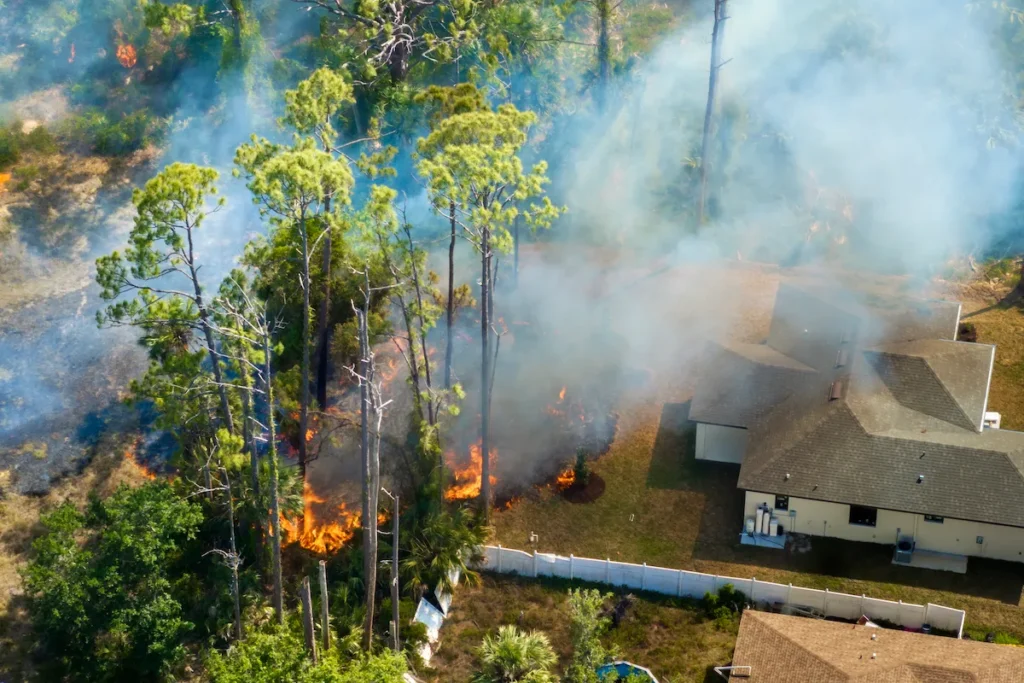
If you live anywhere in the Los Angeles basin, fire isn’t an abstract worry. The Palisades and Eaton fires of January 2025 destroyed more than 16,000 structures and pushed entire neighborhoods to rebuild from the foundation up. The Woolsey fire before that, the Getty fire, the Saddleridge fire — every few years, the conversation in LA shifts back to the same painful question: what could we have done differently?
For homeowners standing in the ashes, contractors fielding rebuild calls, and architects redrawing entire elevations, one of the first questions that comes up is about siding. Specifically: is aluminum siding fire resistant, and is it actually a smarter choice than the wood, vinyl, or fiber cement that surrounded so many of the homes that didn’t survive?
That answer matters more now than it did even five years ago — and the details behind it (which test standards, which code zones, what actually happens at the wall surface during a fire) decide whether a home survives the next ember shower or doesn’t. Picking a product, pulling a permit in a Wildland-Urban Interface zone, or signing off on a spec sheet all hinge on understanding those layers before you commit. Let’s start with the direct answer, then unpack what’s behind it.
The Quick Answer: Yes, and Here’s Why That Matters
Aluminum siding is non-combustible under ASTM E136, the standard test used to determine whether a building material will sustain combustion. The base aluminum doesn’t ignite. It doesn’t feed flames. It doesn’t release the kind of toxic smoke that comes off burning vinyl. When tested for surface burning characteristics under ASTM E84, properly finished aluminum siding earns a Class A rating — the highest fire classification available for interior and exterior wall finishes.
For Clicklad’s aluminum cladding system, that rating is documented across two independent third-party evaluation reports: ICC-ES ESR-5054 and QAI CERUS-1051. Both confirm compliance with the 2024 International Building Code, the 2024 International Residential Code, and the 2025/2022 California Building Code — including the wildland-urban interface provisions that govern most of the high-risk neighborhoods in Los Angeles County.
That last point is the one LA homeowners need to underline. Fire-rated aluminum cladding isn’t just “better than wood.” It’s specifically approved for use in Fire Hazard Severity Zones within State Responsibility Areas and Wildland-Urban Interface Fire Areas — the exact designations attached to the canyons, foothills, and hillsides where most of LA’s recent catastrophic fires have burned.
What “Class A” Actually Means
The fire industry uses the term Class A a lot, and it gets thrown around loosely in marketing materials. Here’s what it actually represents:
Class A is the top tier of a three-class system defined by ASTM E84 (also known as the Steiner Tunnel Test). The test runs flame across the surface of a material for 10 minutes and measures two things:
- Flame Spread Index (FSI): how far and how fast flame travels across the material
- Smoke Developed Index (SDI): how much smoke is generated during combustion
To earn Class A, a material must score 0–25 on flame spread and 0–450 on smoke development. Class B allows up to 75 on flame spread; Class C up to 200. For context, untreated red oak is usually around 100. Many vinyl and composite siding products fall into Class C — or worse, never get rated at all because they fail outright.
Per the ICC-ES ESR-5054 report, Clicklad aluminum products tested under ASTM E84 produced a flame spread index of less than 25 and a smoke-developed index of less than 450 — squarely Class A. More importantly, the base material passed ASTM E136, the noncombustibility test that runs material samples in a 750°C vertical tube furnace. ASTM E136 is the gold-standard test cited by the California Building Code for noncombustible materials in wildland-urban interface zones.
In plain language: the aluminum doesn’t burn. The powder-coated finish doesn’t propagate flame. The system as a whole earns the highest rating available.
Aluminum vs. Wood vs. Vinyl vs. Composite: How They Behave in Fire
Compare what happens at the wall surface during a fire and the differences between materials are stark.
Wood siding — cedar, redwood, pine — is combustible. It ignites, sustains combustion, and continues to burn long after the initial flame source is gone. Cedar shake siding has been identified in CAL FIRE post-incident analyses as one of the most consistent contributing factors to home loss in wildland-urban interface fires. Once one shake catches, the fire travels up the wall, into the soffit, and into the attic in minutes.
Vinyl siding doesn’t technically “burn” the way wood does — it melts and then combusts. Vinyl typically begins to soften and deform at around 160°F (well below the radiant heat thrown off by a nearby burning structure) and ignites around 730°F. Once ignited, PVC produces dense black smoke loaded with hydrogen chloride and other toxic byproducts. In neighborhoods affected by the 2025 Palisades and Eaton fires, vinyl-clad homes routinely failed before flames even reached the property line — radiant heat alone was enough to liquefy the siding off the wall and expose the sheathing underneath.
Composite and fiber-cement siding performs better than vinyl or wood in many respects. Fiber cement (think James Hardie and similar products) is non-combustible itself, which is why it has gained traction in California rebuilds. The trade-off is what comes after install: fiber cement boards are heavy — often two to three times the weight of equivalent aluminum panels — which drives up labor, freight, and structural load on framing. The painted finish also needs to be recaulked and repainted on a 7–15 year cycle to stay sealed against UV and moisture, especially in coastal LA microclimates. You get the fire performance, but you sign up for ongoing maintenance. Composite products that incorporate wood fiber, polymers, or organic binders often carry only Class B or Class C ratings, and some have well-documented issues with surface ignition under direct flame impingement and sustained radiant heat.
Aluminum siding sits in a different category entirely. It melts at roughly 1,221°F, but melting and burning aren’t the same thing. The aluminum doesn’t ignite, doesn’t feed the fire, and doesn’t release toxic combustion products. Even when temperatures climb high enough to deform the panels, the wall surface isn’t contributing fuel to the fire — it’s simply failing structurally. That distinction is everything when the fire department is trying to keep a fire from jumping from one home to the next.
Time-to-Ignition: Why Minutes Matter
The most overlooked metric in residential fire safety is time-to-ignition — how long a material can be exposed to flame or radiant heat before it starts burning. In a wildfire, embers are the primary attack vector. They land on roofs, in gutters, against siding, and in vents. The longer your home’s exterior can resist ignition from those embers, the better the odds that firefighters arrive in time, that the wind shifts, or that the fire skips your structure entirely.
Wood siding can ignite from ember exposure in under 30 seconds under sustained dry, windy conditions. Vinyl typically deforms within 2–3 minutes of exposure to radiant heat from a neighboring burning structure and ignites shortly after. Fiber cement provides longer protection but can crack and fail at joints under prolonged thermal stress.
Aluminum siding, because it never ignites at all, has effectively an infinite time-to-ignition under ember and radiant exposure conditions that would consume other materials. Embers landing on a Clicklad-clad wall don’t find fuel to start a fire. Radiant heat from a neighbor’s burning home heats the aluminum but doesn’t propagate flame across the wall surface.
For a homeowner, that translates into something concrete: more time. More time for the wind to shift. More time for fire crews to arrive. More time to evacuate safely. In the Palisades fire, post-incident accounts repeatedly highlighted families who had only minutes to leave — and houses that were lost because their exterior cladding gave embers a foothold before crews could intervene.
What Recent LA Fires Taught Us
The January 2025 fires were not the first wake-up call, but they were the most expensive. Insured losses are projected to exceed $30 billion, and the rebuild is reshaping how homeowners, builders, and CAL FIRE think about exterior materials. A few patterns have emerged from the post-incident analyses:
- Cladding is a primary failure point. When investigators walked through neighborhoods like Pacific Palisades and Altadena, the homes that survived intact were disproportionately those with non-combustible siding, ember-resistant vents, and Class A roofs. Homes lost to the fire frequently failed at the wall — often before the main fire front even arrived.
- Wildland-urban interface codes work — when they’re applied. California’s Chapter 7A (now embedded in CRC R337 and the 2025 California Wildland-Urban Interface Code) requires noncombustible or fire-resistant exterior materials in designated fire hazard zones. Homes built or rebuilt to these standards have measurably better survival rates.
- Voluntary upgrades pay off. Many of the homes that survived weren’t required by code to use noncombustible siding — the owners chose it. With insurance carriers now pulling out of high-risk zip codes or pricing premiums beyond what most families can absorb, the calculus around upgrading siding has changed permanently.
- The “ember intrusion” failure mode is the one to design against. Direct flame contact accounts for fewer home losses than ember showers landing on combustible cladding, decks, and roof edges. A cladding system that gives embers nothing to ignite is the single highest-leverage upgrade most homes can make.
Clicklad’s Specific Certifications and Test Data
For homeowners, contractors, and architects who want to know exactly what they’re specifying, here’s what the documentation shows for Clicklad aluminum cladding:
ICC-ES ESR-5054 (Issued December 2025)
This is the official third-party evaluation report your local building department, structural engineer, and insurance carrier will reference during permit review. Open the full document to see the complete fire test data, code compliance breakdown, and California WUI approval language exactly as ICC-ES issued it.
→ View the Full ICC-ES ESR-5054 Report (PDF)
PDF — issued December 2025 by ICC Evaluation Service
- Compliance with 2024, 2021, 2018, and 2015 IBC and IRC
- Noncombustible per ASTM E136
- Surface burning: flame spread index < 25, smoke-developed index < 450 (Class A per ASTM E84)
- Approved for interior wall finishes where Class A is required (IBC Table 803.13, IRC R302.9)
- City of LA Supplement: complies with 2023 LABC Chapter 14 and LARC Chapter 7
- CA Supplement: complies with 2025 and 2022 CBC and CRC, including DSA and OSHPD amendments
- Approved for use in Fire Hazard Severity Zones within State Responsibility Areas and Wildland-Urban Interface Fire Areas (per 2025 California Wildland-Urban Interface Code Section 501.4.1 and 2022 CBC Section 707A.3 / CRC Section R337.7.3)
QAI CERUS-1051 (Published February 2025)
If you’re rebuilding in a California Wildland-Urban Interface zone, this is the documentation that proves Clicklad meets CBC 707A.3 and CRC R337.7.3 — the exact code sections your AHJ will check. The full QAI report includes the complete ASTM E136 non-combustibility test results and the manufacturing quality assurance audit from QAI’s California laboratory.
→ View the Full QAI CER-US-1051 Report (PDF)
PDF — published February 2025 by QAI Laboratories
- Compliance with 2024 IBC, 2024 IRC, 2022 CBC, 2022 CRC
- Approved for Construction Types I through V/B
- Non-combustible classification per ASTM E136 with flame spread less than 50
- Class A interior finish rating per ASTM E84
- Approved for use in California wildfire-prone areas under CBC 707A.3 / CRC R337.7.3
- Manufactured in Gardena, CA under QAI Laboratories quality assurance inspection
Material specifications
- 1.4mm (0.055″) thick 6063 aluminum siding panels (T5 or T6 temper)
- 2.5mm (0.098″) thick 6063-T6 aluminum click rails
- Powder-coated finish
- 80% recycled aluminum content
That’s an unusually deep stack of fire documentation for a residential cladding product. ICC-ES, QAI, the City of LA, and CAL FIRE compliance pathways are all covered — which is precisely the documentation your local AHJ, your insurance carrier, and your structural engineer will want to see during permitting and rebuild reviews.
Why Aluminum Doesn’t Spread Fire the Way Other Materials Do
To understand why aluminum cladding behaves so differently in a fire, it helps to think about what fire actually needs: fuel, oxygen, and heat. Wood and vinyl supply their own fuel — once ignited, they sustain the fire even after the original ignition source is gone. The fire travels up the wall, into the eaves, and across to the next structure.
Aluminum supplies no fuel. The base metal is non-combustible. The powder-coat finish is engineered to resist surface flame spread, scoring well below the Class A threshold under ASTM E84. The click-rail system used to mount Clicklad panels is also extruded from 6063-T6 aluminum and tested as a non-combustible composite — meaning every component of the wall assembly, from the rail behind the panel to the panel face you see, is rated together.
There’s no organic core. No PVC layer. No wood fiber. No polymer binder. Just aluminum and a thin, fire-tested coating. When the fire department arrives, they’re not fighting a wall that’s actively contributing to the fire — they’re fighting a wall that’s holding the line.
This is the same principle that made aluminum the cladding of choice for fire-rated commercial construction long before residential builders started paying attention. What’s changed in the last five years — particularly in California — is that the residential market has caught up to what commercial specifiers have known for decades.
Considerations Beyond Fire
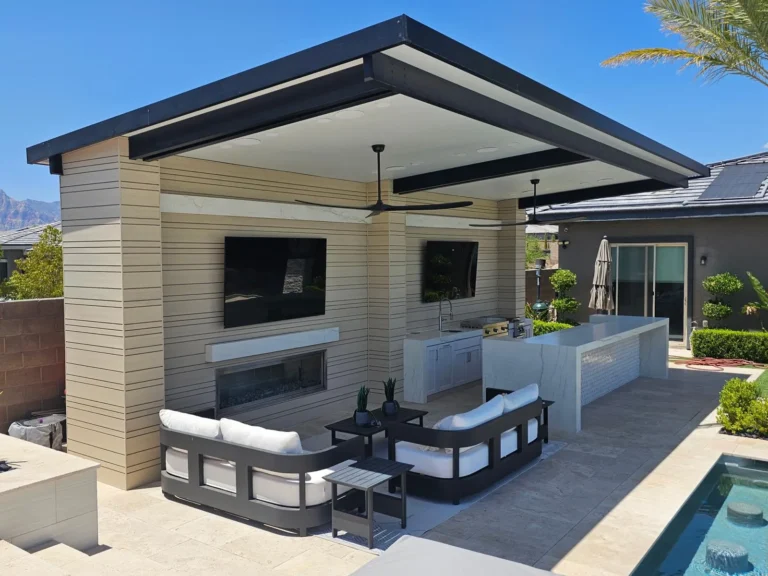
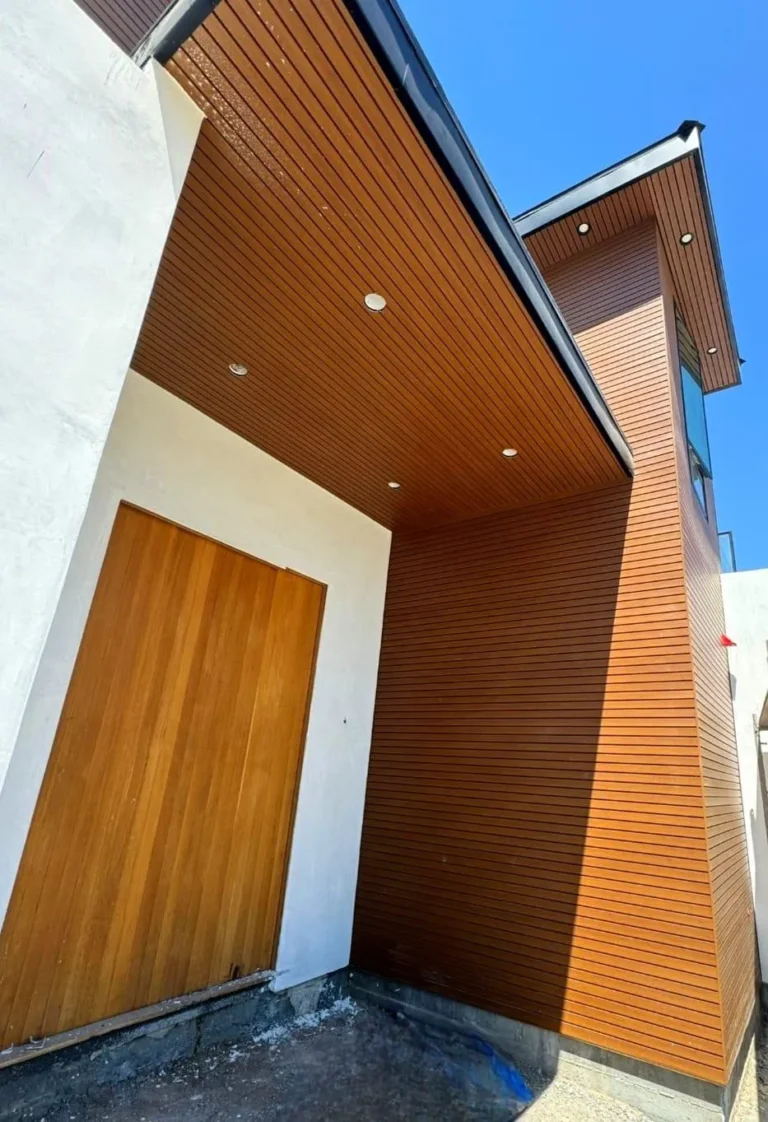
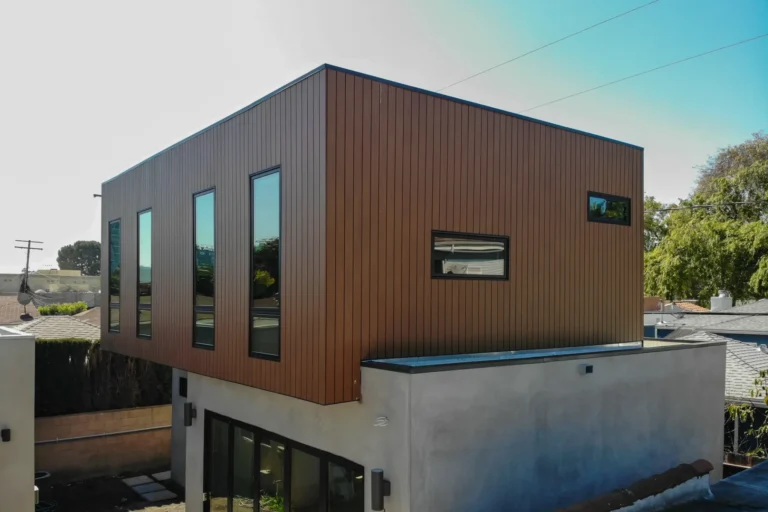
Fire performance is the headline reason LA homeowners are switching to aluminum, but it’s not the only one. And worth saying directly: choosing fire-rated aluminum doesn’t mean accepting a cold, industrial look. Modern wood-grain finishes, deep matte powder coats, and Clicklad’s clean linear profiles deliver the warmth of cedar or the precision of contemporary architecture with no visible fasteners — the safety upgrade is invisible, and the design is the one you wanted.
- Insurance: carriers are increasingly factoring exterior materials into both eligibility and premium calculations in WUI zones
- Permanent finish: powder-coated aluminum doesn’t rot, warp, or feed termites, and Clicklad offers wood-grain finishes that capture the look of cedar without the fire risk
- Click installation: Clicklad’s patented click-to-install system uses no screws or nails through the panel face, which protects the finish and speeds installation
- Sustainability: 80% recycled content reduces embodied carbon vs. virgin aluminum or composite alternatives
- Long-term value: unlike vinyl, which becomes brittle and chalky in 10–15 years under California sun, aluminum with quality powder coating holds its appearance for decades
Frequently Asked Questions
Is aluminum siding fire resistant enough for a Wildland-Urban Interface zone in California?
Yes. Clicklad aluminum siding is documented as compliant with 2025 California Wildland-Urban Interface Code Section 501.4.1 and 2022 CBC Section 707A.3 / CRC Section R337.7.3 via ICC-ES ESR-5054. It meets the noncombustible material performance requirements when tested per ASTM E136, which is the standard cited by California's WUI provisions for use in Fire Hazard Severity Zones within State Responsibility Areas.
Does aluminum siding melt in a fire?
Aluminum melts at approximately 1,221°F, but melting is not the same as burning. In residential fires, even severe ones, the radiant heat at the wall surface is typically lower than the melting point of aluminum, and the metal does not contribute fuel to the fire. Even where aluminum panels do deform under extreme heat, they don't ignite, don't release toxic smoke, and don't propagate flame to adjacent structures the way wood, vinyl, or composite cladding can.
What's the difference between Class A and "non-combustible"?
Class A is a surface burning characteristic rating from ASTM E84 — it measures flame spread and smoke development on the visible surface. Non-combustible is a material property tested by ASTM E136, measuring whether the base material itself can sustain combustion. Clicklad aluminum products achieve both: Class A surface rating and non-combustible base material. That dual classification is what allows the product to be specified in California WUI zones and Type I-IV construction.
Can aluminum siding be installed over an existing wood-frame home?
Yes. Clicklad's click-rail system installs over standard wood-frame construction (minimum 16" o.c. studs) with a code-compliant water-resistive barrier. The siding does not need to be installed over a steel-framed wall to deliver its fire-rating benefits. Its noncombustibility protects the cladding plane itself, which is the surface most exposed to embers and radiant heat during a wildfire.
Is fire-rated aluminum siding more expensive than wood or fiber cement?
On a strict cost-per-square-foot basis, aluminum cladding sits above vinyl and basic wood siding and roughly comparable to high-end fiber cement when finishes and trim are factored in. When you account for insurance considerations in WUI zones, lifetime maintenance (none for aluminum vs. repainting/recaulking cycles for fiber cement), and the cost of not surviving a wildfire, the long-term value calculation has shifted dramatically in aluminum's favor for California homeowners.
Building or Rebuilding in LA? Here’s What to Do Next
If you’re rebuilding after the 2025 fires, planning a renovation in a WUI zone, or specifying cladding for a new project anywhere in California, the case for aluminum siding has never been stronger. The Class A fire rating, ASTM E136 noncombustibility classification, and California WUI compliance documented in ICC-ES ESR-5054 and QAI CERUS-1051 give you the paper trail your AHJ, insurer, and structural engineer will need — and the real-world performance your family will need.
To explore Clicklad’s full line of fire-rated aluminum cladding — including wood-grain finishes, the patented click-to-install system, and the waterproof and rainscreen variants — visit our product page, browse completed projects in our galleries, or contact our team for samples, technical specifications, and a quote tailored to your project.
Fire safety in Los Angeles isn’t theoretical anymore. The cladding on your home is the first thing embers touch and the last thing standing between your family and a fire on your street. Make it count.