
Specifying exterior cladding for a fire hazard zone used to be a paperwork exercise. Pull the manufacturer’s brochure, check that “Class A” appeared somewhere, attach it to the submittal, move on. The 2025 Palisades and Eaton fires changed that. AHJs, insurance carriers, and code consultants now want to see the underlying test data and the specific code citations behind every fire-performance claim.
For architects working in California, Class A fire rated cladding is no longer a marketing label. It’s a chain of evidence that runs from a Steiner tunnel test in a certified lab, through an ICC-ES evaluation report, into the building permit, and onto the wall. This guide unpacks every link.
If you want the homeowner-level overview first, our earlier piece on whether aluminum siding is fire resistant covers the basics. The rest of this article assumes you’re reading a submittal, not a brochure.
The Quick Answer for Spec Writers
Class A fire rated cladding is wall material that scores a flame spread index of 0 to 25 and a smoke developed index of 0 to 450 when tested under ASTM E84 (the Steiner Tunnel Test). For exterior wall applications in fire-prone zones, that surface rating is often paired with a separate non-combustibility classification under ASTM E136. Aluminum cladding achieves both intrinsically because the substrate itself doesn’t combust. For Clicklad’s system, both ratings are documented in ICC-ES ESR-5054 and QAI CERUS-1051. That’s the documentation a code official or insurer will look for.
What “Class A” Actually Means Under the IBC and IRC
The IBC and IRC both reference the same three-class surface burning classification for interior wall and ceiling finishes (IBC Section 803, IRC Section R302.9). The classes are defined by performance under ASTM E84 (or the equivalent UL 723):
| Class | Flame Spread Index | Smoke Developed Index | Typical materials |
|---|---|---|---|
| Class A | 0 to 25 | 0 to 450 | Aluminum, steel, gypsum, fiber cement, mineral wool |
| Class B | 26 to 75 | 0 to 450 | Some treated woods, certain composites |
| Class C | 76 to 200 | 0 to 450 | Untreated red oak (FSI around 100), some vinyl, particleboard |
Anything over an FSI of 200 is unclassified and effectively unusable in any code-regulated wall finish application. The class itself doesn’t speak to non-combustibility, only to how flame travels across the surface and how much smoke is produced.
The smoke developed index cap of 450 applies to all three classes; the flame spread index is the differentiator. A material with an FSI of 24 and an SDI of 449 is Class A; an FSI of 26 is Class B. There’s no partial credit.
For exterior wall covering applications, IBC Chapter 14 sets additional combustibility and assembly-level requirements that go beyond surface burning. That’s where ASTM E136 and, for some assemblies, NFPA 285 enter the conversation.
How the Steiner Tunnel Test Actually Works
The test, developed by Albert J. Steiner at Underwriters Laboratories in the 1940s, is deceptively simple. A horizontal tunnel, 25 feet long and 17.75 inches wide, is lined on its ceiling with the test specimen. A gas burner at one end produces a controlled flame while air is drawn through the tunnel for ten minutes. Two outputs are recorded: flame travel across the specimen (the flame spread index) and light obscured by smoke at the exhaust end (the smoke developed index). Red oak is the calibration standard, indexed at 100 for both.
Three things matter for spec writers reading an E84 report:
- The specimen is mounted on the ceiling, so the test measures flame spread under the most aggressive condition. Floor or wall mounting would give artificially better numbers.
- The result is for the surface, not the assembly. A Class A surface mounted over a combustible substrate doesn’t make the wall non-combustible.
- The 10-minute duration is fixed. Marketing claims of “extended duration” E84 results aren’t compliant with the standard.
Aluminum panels with a powder-coated finish pass E84 comfortably because there’s essentially no organic content to combust. The flame can’t propagate across a metal surface without fuel. The smoke index measures whatever the powder coating contributes, which for a properly formulated architectural finish is well below the 450 cap.
Non-Combustible Under ASTM E136 vs. Class A Under ASTM E84
This distinction catches the most spec writers, and it matters because the California Building Code, IBC Chapter 7, and several insurance underwriters cite both standards independently.
ASTM E136 measures whether a material itself can sustain combustion. A 1.5-inch cubic specimen is placed in a vertical tube furnace at roughly 750 degrees Celsius for 30 minutes. The material passes if temperature rise, flaming, and weight loss stay within strict limits. It’s binary: either the material is non-combustible or it isn’t.
ASTM E84, by contrast, doesn’t say anything about whether the base material burns. It only measures how flame and smoke move across the surface. A combustible material can still earn Class A if its surface burns slowly and produces limited smoke (some treated wood products do this).
Aluminum is one of the few cladding substrates that comfortably passes both. For Clicklad specifically:
- ASTM E136 (non-combustibility): the 6063-T5/T6 aluminum substrate passes
- ASTM E84 (surface burning): flame spread index less than 25, smoke developed index less than 450
That dual classification is what makes aluminum specifiable in IBC Type I and Type II non-combustible construction, in California Chapter 7A WUI zones, and in jurisdictions that require both ratings independently.
What NFPA 285 Adds for Wall Assemblies
For exterior wall assemblies that contain combustible components (continuous insulation, water-resistive barriers with foam plastic, MCM panels with polymer cores), IBC Section 1402 typically requires the assembly to be tested under NFPA 285.
NFPA 285 is a two-story full-scale fire test that measures vertical and lateral fire propagation across an assembled wall, not just one component’s surface. A gas burner simulates a room flashover; the wall is evaluated for flame propagation onto the second story, lateral spread, and temperature rise behind the cladding.
For a 100% aluminum cladding system with no combustible insulation, polymer core, or foam plastic, NFPA 285 typically isn’t triggered. But for any project pairing aluminum cladding with foam-plastic continuous insulation, a thermoplastic-core MCM panel, or a combustible WRB, the assembly-level test becomes the gating item.
Specifying for a fire-zone project right now? The ICC-ES ESR-5054 and QAI CERUS-1051 reports are available in Clicklad’s resources library. For a project-specific consult on assembly detailing or code-pathway questions, get in touch with our team and we’ll walk through the right system for your wall section.
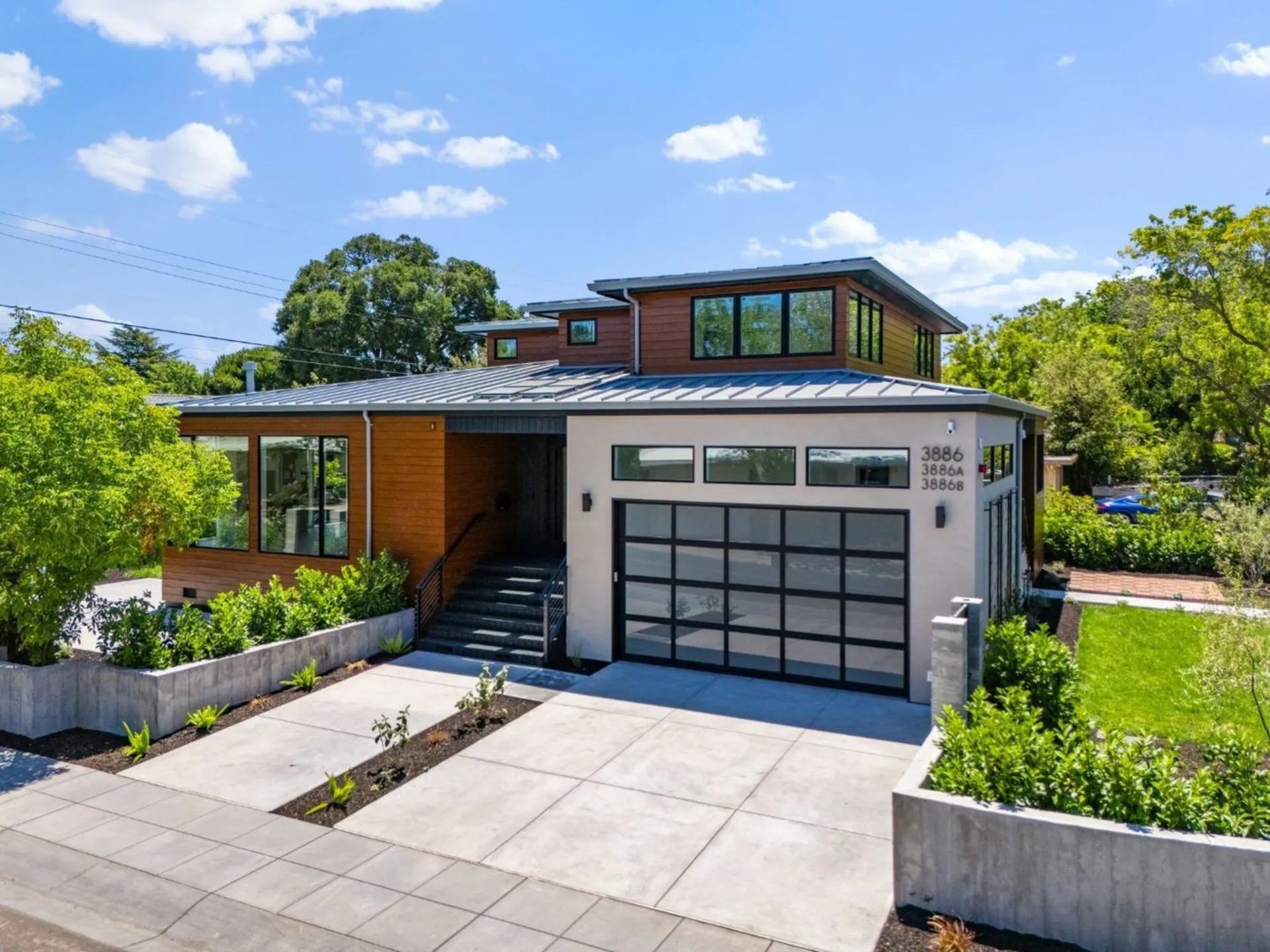
Why Aluminum Achieves Class A Intrinsically
A Class A rated wood product (treated SPF lumber, FRT plywood) gets its rating from a chemical treatment. If it’s sanded off, weathered out, or chemically degraded, the rating can be lost. FRT manufacturers publish service-life and re-treatment guidance for this reason.
Aluminum needs no such treatment. The 6063-T5/T6 alloy used in architectural extrusions is roughly 98% aluminum by weight with small additions of magnesium and silicon. None of those constituents are combustible at temperatures encountered in any normal fire scenario. The powder-coat finish is the only organic component, and architectural powder coatings are formulated to score well below the Class A threshold on a non-combustible substrate.
This intrinsic non-combustibility carries through the full assembly when supporting components are also aluminum. Clicklad’s patented click-rail system uses 2.5mm 6063-T6 click rails behind a 1.4mm 6063 panel face; both pass ASTM E136. Clicklad’s 80% recycled aluminum content doesn’t affect fire performance: recycled and primary aluminum behave identically at the chemistry level.
How to Read an ICC-ES Evaluation Report
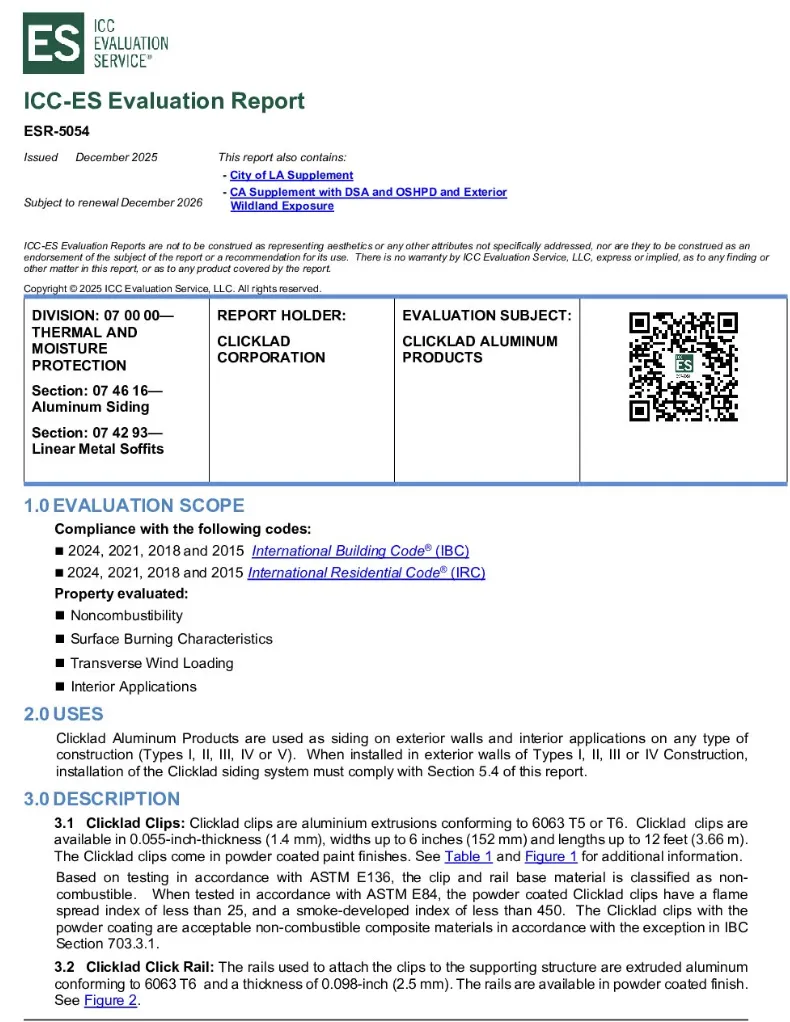
An ICC-ES Evaluation Service Report (ESR) bridges a manufacturer’s test data and a building official’s code review. The reports are published by ICC-ES after the manufacturer submits test data from accredited labs and the report is peer-reviewed by ICC-ES engineers. Building officials across most U.S. jurisdictions accept current ESRs as evidence of code compliance.
The structure of an ESR follows a predictable template. Using Clicklad’s ESR-5054 as the working example:
- Section 1, Evaluation Scope. Codes and code editions covered. Look for the IBC and IRC editions your project is permitted under, plus state amendments.
- Section 2, Uses. Applications the report covers, with restrictions on construction type or assembly.
- Section 3, Description. Material specs, system components, installation method. For ESR-5054, 6063 aluminum, T5/T6 temper, 1.4mm panel, 2.5mm rail, powder-coated finish.
- Section 4, Design and Installation. Fastener spacing, framing, deflection limits, attachment to substrate.
- Section 5, Conditions of Use. Limits on where the product can be used. Binding; ignoring them voids the code-compliance pathway.
- Section 6, Evidence Submitted. Test reports the ESR is based on. For fire-rated products this is where ASTM E84 and E136 references appear.
- Section 7, Identification. Labels or markings the installed product must bear so an inspector can match it to the ESR.
For ESR-5054 specifically, the document covers 2024, 2021, 2018, and 2015 editions of the IBC and IRC; the California Supplement covers 2025 and 2022 CBC and CRC; and the City of Los Angeles Supplement adds 2023 LABC Chapter 14 and LARC Chapter 7. The report confirms ASTM E136 non-combustibility, ASTM E84 Class A surface burning (FSI less than 25, SDI less than 450), and approves use in Fire Hazard Severity Zones within State Responsibility Areas and Wildland-Urban Interface Fire Areas per 2025 California WUI Code Section 501. Beyond the ICC-ES report, Clicklad Aluminum Siding also carries CAL FIRE OSFM Building Materials Listing No. 8175-2405:0001, which independently lists it as noncombustible (ASTM E136-19) for exterior siding in Wildland-Urban Interface areas.4.1 and 2022 CBC Section 707A.3 / CRC R337.7.3.
The companion QAI CERUS-1051 report, published February 2025 by QAI Laboratories, independently confirms compliance with 2024 IBC, 2024 IRC, 2022 CBC, and 2022 CRC; approves Construction Types I through V/B; and verifies the same E136 and E84 results. Two independent third-party evaluations on the same product gives a specifier two parallel compliance paths.
What Spec Writers Should Require in Submittals
A spec that asks for “Class A fire rated aluminum cladding” without test-method or report citations puts the AHJ in the position of accepting marketing claims at face value. A tighter spec gives the building official, the contractor, and the eventual inspector a clear bar to hit.
Five line items belong in every fire-related cladding submittal:
- Substrate material and standard. Cite the alloy and temper (for aluminum, 6063-T5 or T6), the panel and rail thickness, and the material standard. For Clicklad, 6063-T5/T6 per ASTM B221.
- Non-combustibility test method. Cite ASTM E136 specifically and require submission of the test report or third-party evaluation referencing it.
- Surface burning characteristics. Cite ASTM E84 and require the actual FSI and SDI values, not just “Class A.” “FSI less than 25 and SDI less than 450 per ASTM E84” gives the inspector a measurable bar.
- Third-party evaluation report. Require a current ICC-ES ESR or equivalent (QAI CERUS, UL listing) covering the IBC and IRC editions your jurisdiction has adopted. For California, also require a current California Supplement.
- Assembly compatibility. If the wall includes any combustible component (foam continuous insulation, combustible WRB, MCM panel with thermoplastic core), require NFPA 285 documentation for the full assembly.
For the broader California compliance pathway (Chapter 7A, R337, the 2025 Wildland-Urban Interface Code), see our companion guide on WUI Chapter 7A aluminum cladding in California. This article focuses on test methods and ICC-ES reports; the WUI piece focuses on the California code path itself.
The Bottom Line
Class A fire rated cladding is the floor, not the ceiling, of what a fire-zone specification should require. For aluminum, the Class A surface rating under ASTM E84 is paired with non-combustibility under ASTM E136, and both are documented in third-party evaluation reports (ICC-ES ESR-5054 and QAI CERUS-1051 in Clicklad’s case) that translate the test data into code-compliance pathways under the IBC, IRC, CBC, CRC, and the 2025 California WUI Code. Architects who pull those reports during design avoid surprises at plan check, submittal review, and insurance underwriting.
The category has matured. The documentation exists. The code pathways are written. The remaining work is on the spec sheet.
Have a real project that needs this kind of spec backing? The Clicklad team works directly with architects, code consultants, and contractors on Class A fire rated cladding specifications for California WUI zones and high-rise non-combustible assemblies. Talk to our team and we’ll respond with the right system, the matching evaluation report sections, and the assembly detailing for your project.
Frequently Asked Questions
What's the difference between Class A fire rated cladding and non-combustible cladding?
Class A is a surface burning rating under ASTM E84, measuring flame spread and smoke development on a material's visible face. Non-combustible is a base-material property under ASTM E136. A material can be Class A without being non-combustible (some treated wood products). Aluminum cladding achieves both, which is what makes it specifiable in IBC Type I and II construction and in California WUI zones.
Do I need NFPA 285 testing for an aluminum cladding wall assembly?
It depends on the assembly. If every component (cladding, attachment system, continuous insulation, water-resistive barrier, sheathing) is non-combustible per ASTM E136, NFPA 285 is generally not triggered by IBC Section 1402. If the assembly includes any combustible component (foam plastic insulation, combustible WRB, MCM panel with thermoplastic core), NFPA 285 testing or a published assembly listing typically becomes a code requirement.
What test reports should I require in a Class A fire rated cladding submittal?
At minimum: an ASTM E84 test report from an accredited lab showing FSI less than 25 and SDI less than 450; an ASTM E136 report confirming non-combustibility; and a current third-party evaluation report (ICC-ES ESR, QAI CERUS, or UL listing) covering the code editions your project is permitted under. For California projects, also require the California Supplement. For assemblies with combustible components, add NFPA 285 documentation.
Is the powder-coat finish on aluminum cladding part of the Class A rating?
Yes. The Class A rating from ASTM E84 measures the surface as installed, which includes the powder-coat finish. Architectural powder coatings on aluminum are formulated to contribute minimal flame spread and smoke development, which is why aluminum systems with quality powder coatings score well below the Class A thresholds. The substrate's ASTM E136 non-combustibility is a separate measurement on bare aluminum, unaffected by the finish.