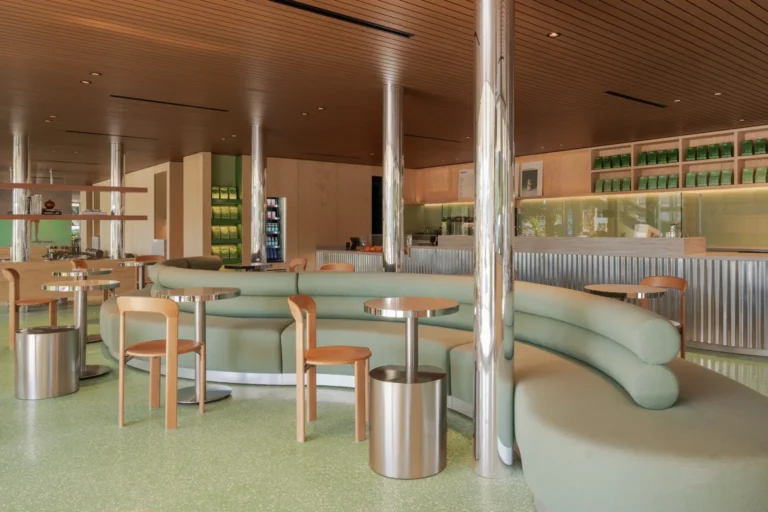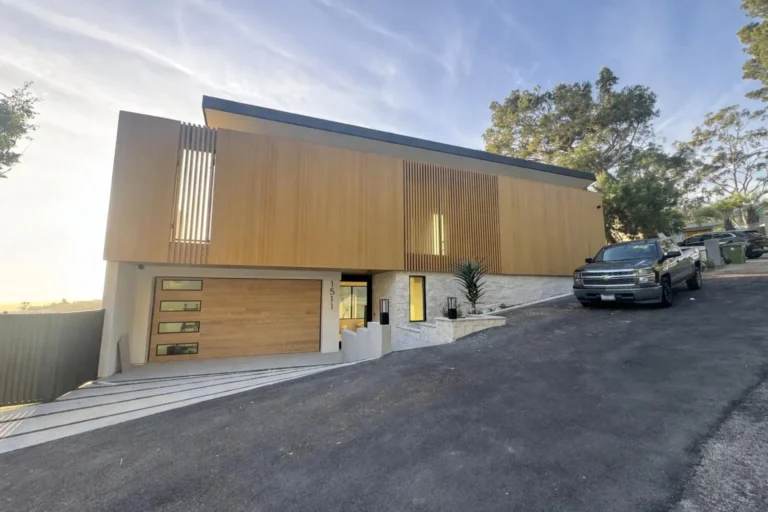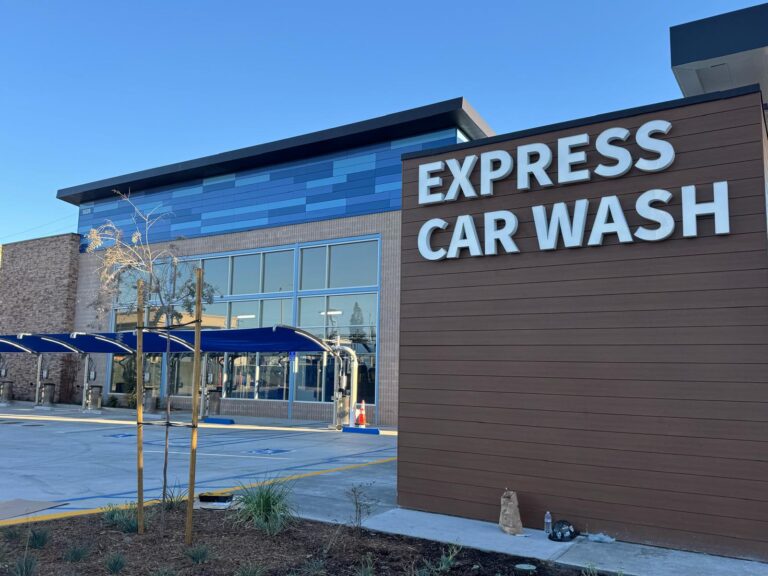

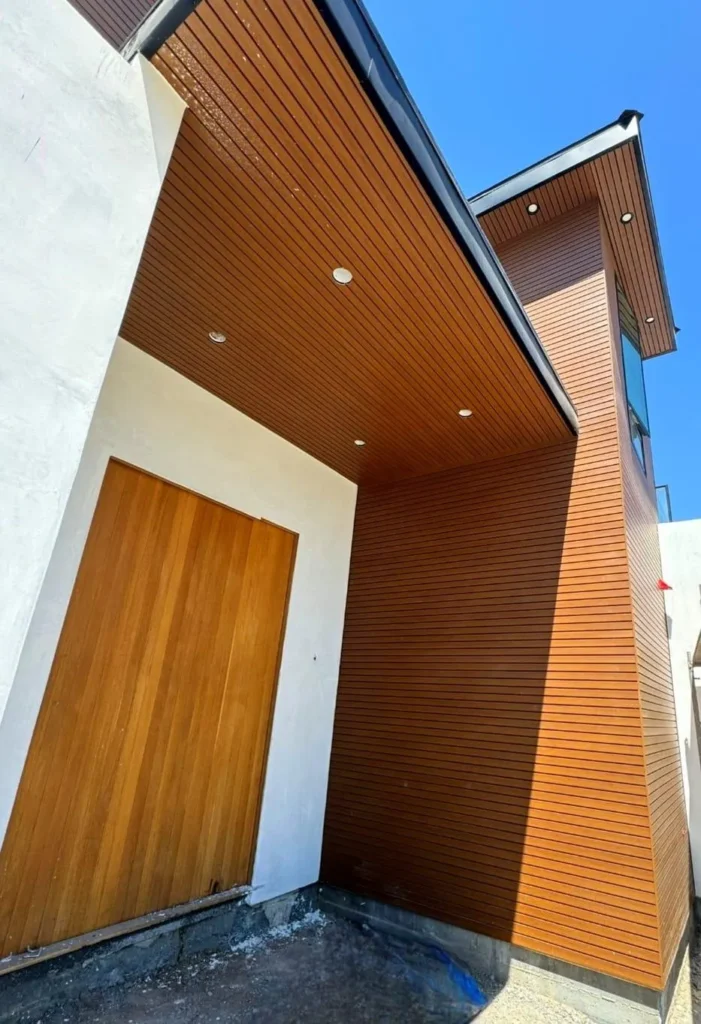
Walk through any new architectural project in Los Angeles County and the facade conversation now starts with finish before it starts with material. Matte charcoal on a Venice ADU. Champagne anodized on a Beverly Hills office remodel. Sublimated walnut on a Manhattan Beach craftsman rebuild. Soft sage powder coat on a Pasadena duplex. All four are the same underlying product: aluminum cladding. The look comes from how the panel was finished.
The catalog of aluminum cladding colors and finish options is wider than most designers realize, and the differences between finish types aren’t just aesthetic. A powder coat behaves differently from an anodized surface under UV. PVDF outlasts standard powder coat on chalk and fade. Sublimated wood-grain belongs in its own category. And the AAMA spec attached to the finish (2603, 2604, or 2605) determines whether a 25-year facade warranty actually means anything.
This guide is the practical survey. We’ll cover the four main finish technologies, the color families inside each, what RAL and custom matching looks like in production, and how to choose a finish for residential, commercial, or wildland-urban interface use.
The Quick Answer: What Your Color and Finish Options Actually Are
Aluminum cladding is finished using one of four main technologies: powder coating (the most common, available in any RAL color, matte through gloss), anodized (an electrochemical surface treatment in metallic silver, champagne, bronze, or black), PVDF/Kynar 500 (a fluoropolymer liquid coating used on high-end architectural facades), or sublimated wood-grain (digital wood imagery fused into a powder coat base). Color families inside these finishes cover solids (neutrals, deep tones, bold accents), metallics, wood-look, and weathered/patina effects. Custom RAL matching is standard on production runs above the manufacturer’s minimum order quantity.
The decision isn’t usually “which color” first; it’s “which finish technology” first, because the finish dictates the available palette, the price, and the warranty duration.
The Four Finish Technologies and How They Differ
Most architectural aluminum on the market falls into one of four finish categories. Each is manufactured differently and performs differently outdoors.
Powder coating is the dominant finish for architectural aluminum cladding. Dry pigmented polymer powder is electrostatically sprayed onto the cleaned aluminum panel, then baked at roughly 200°C so the powder melts and flows into a continuous film. The result is a uniform, fully sealed coating with no solvents, no VOC emissions, and excellent color consistency batch to batch. Modern powder formulations cover the full RAL palette in matte, satin, semi-gloss, and gloss. The Powder Coating Institute tracks the technology’s growth in architectural metal; it’s now the default architectural finish in North America.
Anodizing is fundamentally different from a coating. Instead of adding material on top of the aluminum, anodizing grows a controlled oxide layer out of the aluminum surface itself by passing electrical current through an acid bath. The oxide is hard, integral to the metal, and accepts dye in a limited palette (clear/silver, champagne, light bronze, medium bronze, dark bronze, and black). Anodized finishes don’t chalk, don’t peel (the finish isn’t a separate layer that can detach), and develop a soft metallic depth that powder coat can’t quite match. The trade-offs: limited color range, sensitivity to alkaline cleaners, and visible weld and scratch lines that powder coat would conceal.
PVDF (polyvinylidene fluoride), commonly sold under the Kynar 500 brand, is a liquid fluoropolymer coating spray-applied and oven-cured. It’s the highest-performing finish for outdoor color retention. PVDF holds color and gloss longer than standard powder coat under aggressive UV, salt, and pollution exposure. Most large commercial curtainwall and architectural metal facades in coastal U.S. markets specify a 70% PVDF finish to AAMA 2605. The downsides are higher cost (typically 15 to 30 percent above an equivalent powder coat) and a more demanding application process that requires factory spray lines rather than smaller in-house powder lines.
Sublimated wood-grain is a hybrid: a base powder coat plus a heat-transferred wood-grain pattern that vaporizes into the cured polymer at roughly 200°C. The grain becomes part of the coating chemistry, not a film on top of it. This is its own finish category because the surface behaves differently from a flat-color powder coat under wear and UV. For the full deep-dive on the manufacturing process, performance, and cedar comparison, see aluminum siding wood grain.
| Finish technology | How it works | Color range | Outdoor life | Typical AAMA spec |
|---|---|---|---|---|
| Powder coat | Dry polymer powder electrostatically sprayed, baked into a continuous film | Full RAL palette, matte to gloss | 20 to 40+ years | 2603 to 2605 depending on formulation |
| Anodized | Controlled oxide layer grown electrochemically; dye absorbed into the oxide | Silver, champagne, bronze, black | 30 to 40+ years | AAMA 611 (separate anodized spec) |
| PVDF / Kynar 500 | Liquid fluoropolymer spray-applied, oven-cured | Full color range including metallics | 30 to 50+ years | 2605 (premium) |
| Sublimated wood-grain | Wood pattern heat-transferred into a cured powder coat | Wood species and custom matches | 30+ years | 2605 base coat |

Aluminum Cladding Colors by Family: Solids, Metallics, Wood, and Weathered
Inside each finish technology, the available aluminum cladding colors fall into recognizable families. Most architectural specs land in one of four.
Solid colors are the largest category and the most flexible. The full RAL palette is available on powder coat and PVDF. Within RAL, four sub-families dominate architectural specs:
- Neutrals. Warm white (RAL 9010), pure white (RAL 9016), classic gray range (RAL 7035, 7038, 7045), and the popular “Anthracite” charcoal (RAL 7016) that’s now the default modern facade color in California from the LA Basin to the Bay Area.
- Deep tones. Jet black (RAL 9005), oxide red (RAL 3009), forest green (RAL 6009), sapphire blue (RAL 5003). Specified on accent walls, soffits, and feature elements where a saturated color anchors a multi-material composition.
- Bold accents. True reds, oranges, and yellows for hospitality, retail, and signage-adjacent uses. Color stability under UV varies by pigment chemistry; reds and oranges historically fade fastest, which is one reason PVDF dominates in those specs.
- Sage, sand, and muted earth tones. The fastest-growing residential family since 2023. Mojave-influenced palettes for ADUs, desert-modern rebuilds, and projects responding to the wildfire-rebuild aesthetic.
Metallics include silver, champagne, bronze, and graphite mica finishes. Powder coat metallics use aluminum or mica flake suspended in the polymer; PVDF metallics use the same. Anodized covers the metallic family through the oxide itself rather than added pigment, which gives anodized metallics a depth that pigmented finishes can approximate but not perfectly match.
Wood-look finishes are the sublimated category covered in detail in the wood-grain article. Light oak, walnut, cedar tone, teak, and custom species matched to a homeowner’s existing reference. Modern programs use scanned grain files that don’t visibly repeat across a facade.
Weathered and patina effects are the smallest but most architecturally interesting family. Specialty powder coats simulate weathered zinc gray-blue, oxidized copper green, and COR-TEN steel orange-brown without the actual oxidation. These finishes deliver the patina aesthetic on a fully sealed substrate that won’t bleed onto adjacent surfaces.
Comparing finish options on a real project? The full Clicklad finish program and AAMA documentation live in /resources/, and the catalog of available colors and substrates is on the aluminum siding product page. For project-specific color guidance, get in touch with our team via /contact-us/ and we’ll walk through the finish best matched to your design intent and code context.
RAL and Custom Color Matching
The RAL color system, originally developed in Germany in 1927, is the global reference for architectural color in Europe and the dominant reference in North American architectural metal. The classic RAL Classic set covers roughly 213 colors; RAL Design extends that to around 1,800; RAL Effect adds metallic and pearl variants. Almost any architectural color a designer is likely to specify maps to a RAL number.
Custom color matching outside the RAL standard is also routine on production runs. A designer can submit a paint chip, a Pantone reference, or a sample of an adjacent material (a stone, a wood, a fabric) and the powder formulator will produce a matched batch. Custom matches usually require:
- A physical reference sample (not a screen color or a printed swatch)
- A minimum order quantity (typically a few hundred square feet for a custom batch)
- A 4 to 8 week lead time for formulation, mixing, and color approval
- Pre-production sign-off on a small painted panel before the full run is coated
Color consistency across batches is one of the most important quality factors in aluminum cladding colors specifications. A facade installed across two production runs with a slight delta-E shift will look like two different walls when the sun hits it at a low angle. Specifying a single batch, or formally accepting a documented inter-batch tolerance, prevents that surprise.
What AAMA 2603, 2604, and 2605 Actually Mean
When a finish spec lists “AAMA 2605,” it’s referencing the American Architectural Manufacturers Association’s three-tier framework for organic coatings on aluminum. The numbers correspond to dramatically different performance levels.
| AAMA spec | Coating tier | South Florida exposure test | Typical warranty | Where it’s used |
|---|---|---|---|---|
| AAMA 2603 | Entry / pigmented organic | 1 year | 5 years | Interior trim, low-exposure commercial, builder-grade |
| AAMA 2604 | Mid / high-performance organic | 5 years | 10 years | Mid-tier commercial, residential cladding |
| AAMA 2605 | Premium / superior performing organic | 10 years | 20 to 30 years | Architectural facades, curtainwall, fire-zone residential |
The South Florida exposure test is the industry’s accelerated reality check: panels mounted on a 45-degree rack facing south, in coastal Florida humidity and UV, for the specified duration. Color shift, chalk, gloss loss, and erosion are measured against pass thresholds defined by ASTM D2244 (color) and ASTM D4214 (chalk).
AAMA 2605 is the only tier that delivers what most architects assume “premium powder coat” means. Specifying 2603 to save cost on a 30-year facade is usually false economy; the finish will show visible chalk and fade within 7 to 10 years and the building will need a recoat or full re-clad decades before the substrate has aged. Clicklad’s standard architectural finish program is formulated to the 2605 level.
How Finish Choice Affects Real-World Performance
Beyond AAMA spec, three finish properties matter on a working facade.
UV stability. PVDF leads, premium powder coat (2605) is close behind, anodized doesn’t pigment-fade at all (the color is in the oxide structure), entry-level powder coat lags. Coastal California and high-desert inland sites are both demanding UV environments and benefit from the upper-tier finishes.
Scratch and abrasion resistance. Anodized is hardest by a noticeable margin because the oxide layer is harder than the underlying aluminum. Powder coat and PVDF are similar to each other (both reasonably abrasion-resistant, both can be scratched by hard impact). For ground-floor applications subject to foot traffic, equipment contact, or vandalism, anodized is the safer specification.
Chalking and washing. All organic coatings will eventually chalk under enough UV exposure (the surface polymer breaks down and releases a powdery residue). 2605 formulations and PVDF chalk slowly; 2603 chalks fast. Annual rinse with mild detergent removes accumulated dust and slows chalking on any finish.
The Clicklad system uses powder coat applied to 6063-T5/T6 aluminum panels (1.4mm panel, 2.5mm click rail) and meets the AAMA 2605 standard. For fire-rated and Chapter 7A wildland-urban interface compliance, the finish doesn’t compromise the substrate’s non-combustibility rating under ASTM E136; certification details live in the ICC-ES ESR-5054 and QAI CERUS-1051 reports.

Choosing a Finish for Your Project Type
The right finish depends as much on building type and exposure as it does on aesthetics.
Residential single-family. Powder coat in a 2604 or 2605 formulation handles most residential exposures and gives the designer the widest color palette. For wood-look elevations on a fire-zone rebuild, sublimated wood-grain on the same powder-coat base. Anodized appears occasionally on contemporary residential when the design wants a metallic depth, often on accent panels rather than full facades.
Mid-rise commercial. PVDF (Kynar 500) to AAMA 2605 is the default for office, retail, and hospitality facades that carry a 20-plus year warranty. The cost premium over powder coat is small relative to the total facade budget and the chalk-and-fade performance is materially better over decade-plus horizons.
Soffits, ceilings, and overhangs. Powder coat is fine; the finish isn’t exposed to direct UV the way a south-facing facade is. Wood-grain shows up frequently here because the warm material reads strongly on the underside surface a person sees when they look up.
Industrial and back-of-house. Powder coat to AAMA 2604 (or even 2603 for short-life utility buildings) is usually adequate. Color choice is driven by branding rather than longevity.
Wildland-urban interface (WUI) and California fire-zone residential. Finish choice doesn’t change the underlying fire performance (the aluminum substrate is non-combustible regardless of finish), but designers in fire-zone rebuilds often choose powder coat in warm earth tones or sublimated wood-grain to recover the natural materiality that wood-clad homes had before they burned. Both options meet Chapter 7A noncombustibility requirements while delivering the aesthetic homeowners want. For more on California fire-zone compliance, see is aluminum siding fire resistant.
The Bottom Line
The library of aluminum cladding colors and aluminum siding finishes has expanded to the point that the limit is design intent rather than manufacturing capability. Almost any color a designer can specify is available in a finish technology that will survive the building’s intended service life, and the entry-level finishes that used to fade and chalk inside a decade have largely been displaced in architectural work by AAMA 2605 powder coat and PVDF.
The practical decision is rarely “what color.” It’s “which finish technology, at which AAMA tier, in which color family.” Answering those three questions together, with the building’s exposure and warranty horizon in mind, produces a spec that holds up across the full ownership life of the facade.
Have a real project that needs a finish recommendation? The Clicklad team works directly with architects, builders, and homeowners on color and finish selection for fire-zone, commercial, and architectural residential projects. Reach out via /contact-us/ and we’ll walk through the right finish, AAMA tier, and color family for your design, site exposure, and timeline.
Frequently Asked Questions
How many aluminum cladding colors are actually available?
In practical terms, any color. Powder coat and PVDF cover the full RAL palette (around 1,800 standardized colors across RAL Classic, Design, and Effect), and custom matching to a paint chip, Pantone reference, or material sample is available on production runs above the manufacturer's minimum order quantity. Anodized is limited to the silver, champagne, bronze, and black metallic family. Sublimated wood-grain covers light oak, walnut, cedar, teak, and custom species matches.
Is anodized aluminum better than powder coat?
It depends on the project. Anodized is harder, doesn't pigment-fade, and develops a metallic depth that powder coat can approximate but not match. Powder coat offers a vastly wider color range, costs less, and is the dominant architectural finish for that reason. For a ground-floor application subject to wear, anodized is often the better call. For a multi-color residential or commercial facade, powder coat to AAMA 2605 is the standard answer.
What does AAMA 2605 mean and is it worth specifying?
AAMA 2605 is the American Architectural Manufacturers Association's top tier specification for organic coatings on aluminum. It requires the finish to pass 10 years of South Florida UV and humidity exposure with minimal color shift, chalk, and gloss loss. For any facade with a 20-plus year warranty horizon, 2605 is the spec that delivers. Lower tiers (2603, 2604) show visible fade and chalk inside a decade on demanding exposures.
Can I match an existing color on my building?
Yes. Custom RAL or non-RAL color matching is standard. The process requires a physical reference sample (a paint chip, an existing panel, or a material the new cladding needs to match), a minimum order quantity, and roughly 4 to 8 weeks of lead time for formulation, batch coating, and color approval. For specific match questions, contact the Clicklad team via /contact-us/ and we'll walk through what's needed.
Does the finish affect fire performance?
No, not on aluminum. The substrate itself is non-combustible under ASTM E136 regardless of the surface finish. Powder coat, PVDF, anodized, and sublimated wood-grain are all thin enough and chemically stable enough that they don't change the panel's Class A ASTM E84 rating. Clicklad's ICC-ES ESR-5054 and QAI CERUS-1051 certifications apply across the finish program, including the wood-grain options.