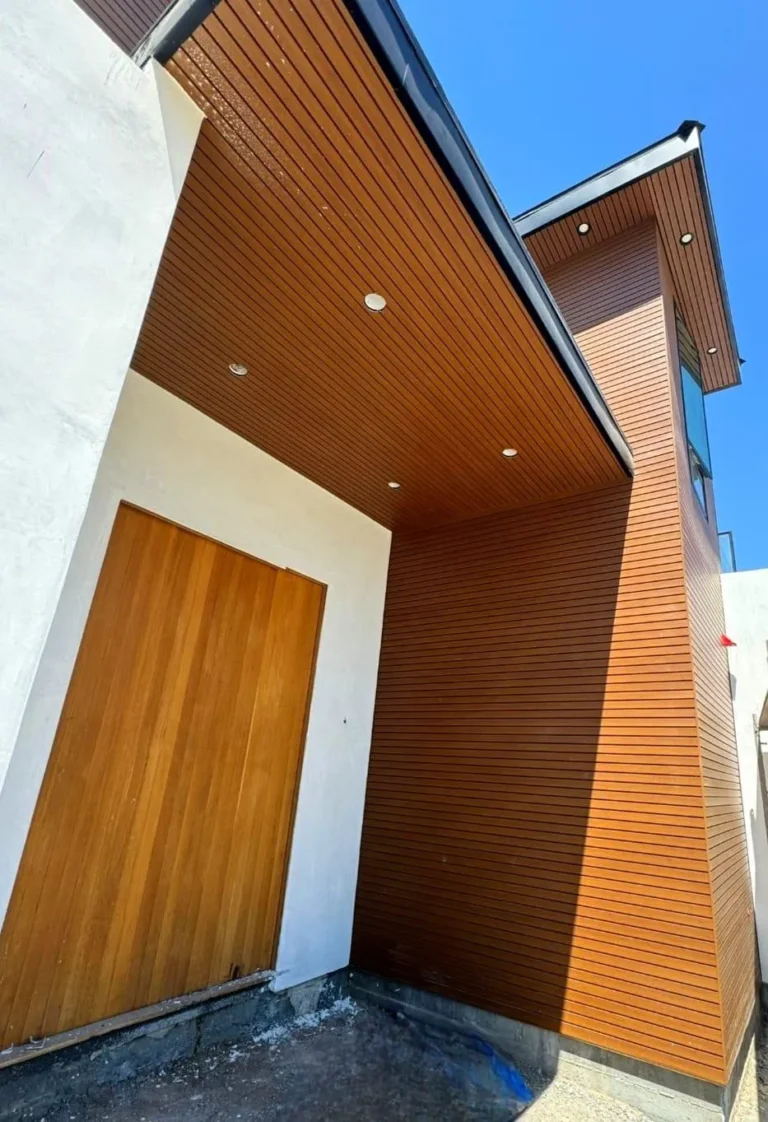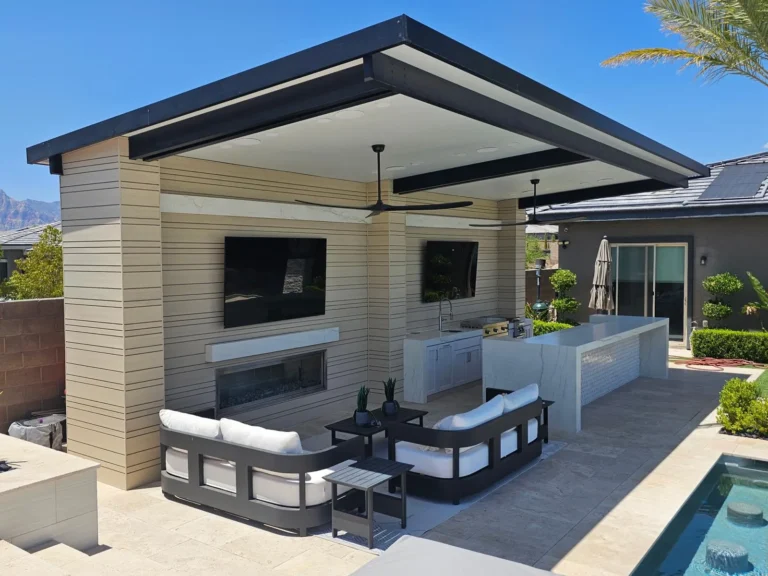

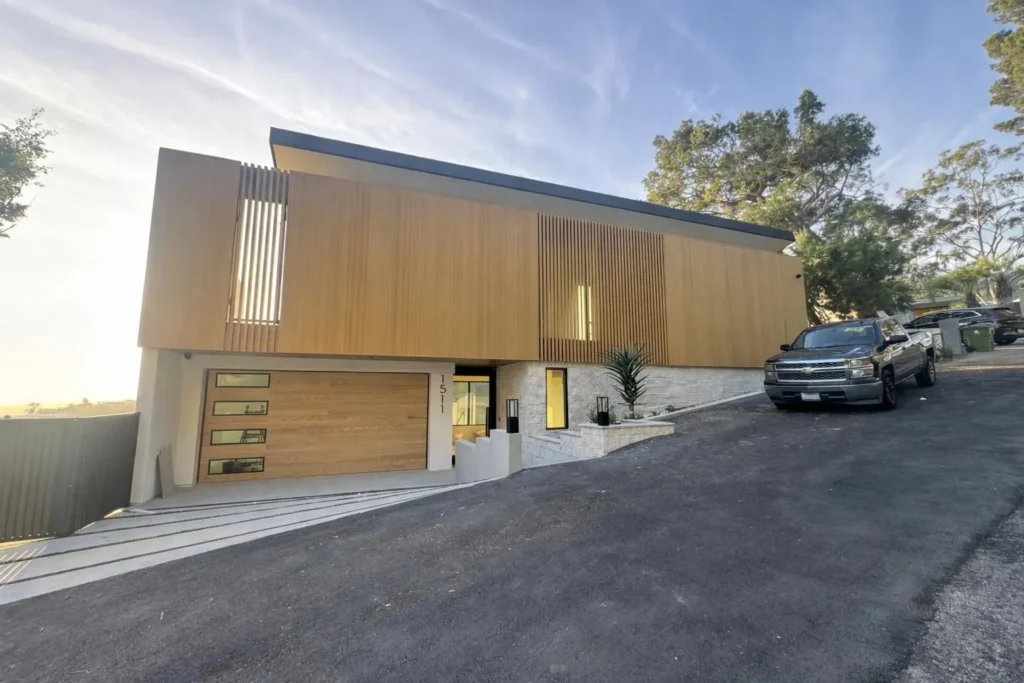
Stand a foot away from a wood-grain aluminum panel finished in the last three years and your eye will tell you it’s cedar. The color depth is right. The grain pattern flows naturally across panel seams. The matte sheen sits in the same range as freshly oiled western red cedar. The weight tells the truth: aluminum is dramatically lighter. And depending on the finish spec, the wood-grain look on that wall holds anywhere from roughly a decade to the full life of the panel, without ever needing the sealing, sanding, and recoating that real cedar demands.
This isn’t the old-school “wood-look aluminum” with a printed paper-like surface that started peeling after a year in the sun. The process has changed. Modern aluminum siding wood grain finishes use sublimated polymer transfer and high-performance powder coatings that fuse the wood imagery into the cured coating. The finish’s outdoor life depends on the spec: entry-level sublimation holds for roughly 5 to 10 years before noticeable UV fade; AAMA 2605 powder coats extend that significantly. Either way, the cedar plank on a neighboring home is graying, splitting, and demanding its third recoat long before either spec needs attention.
For architects specifying a 40-year facade, both the substrate and the finish-tier decision matter. So does the cost-of-ownership difference: real cedar carries an ongoing maintenance burden that aluminum doesn’t. This guide breaks down how the finishes are actually manufactured, what AAMA 2605 means in practice and why it’s the spec that decides whether the wood-grain look holds for one decade or several, and where this material earns its place in a project.
The Quick Answer: What Wood-Grain Aluminum Actually Is
Wood-grain aluminum siding is an aluminum panel (typically 6063-T5/T6 alloy) coated with a high-performance polymer finish that has wood-grain imagery sublimated or printed into the surface. The grain pattern is part of the finish, not a film applied on top. Outdoor finish life depends on the spec: a standard sublimated finish holds its color and grain for roughly 5 to 10 years before noticeable UV fade. Premium products formulated to the AAMA 2605 specification carry a 10-year minimum chalk-and-fade rating and routinely deliver multi-decade real-world life. Either is dramatically longer than natural cedar’s 2 to 4 year reseal cycle.
For a Class A fire rated, fully recyclable substrate that looks like cedar at any reasonable viewing distance, this is the only product category that delivers all three.
How Modern Wood-Grain Aluminum Is Made
Three manufacturing processes dominate the category, and they perform very differently over time.
Sublimation transfer is the premium method and the one Clicklad uses on its wood-grain finishes. The aluminum panel is first powder-coated with a base color, baked, and cooled. A polyester film carrying the wood-grain pattern is then wrapped around the panel and heated to roughly 200°C in a controlled oven. At that temperature, the ink turns into vapor and migrates directly into the cured powder-coat polymer. When the film is removed, the wood-grain isn’t a layer on top of the coating; it’s chemically bonded inside it. There is no edge to peel and no surface to scratch off independently of the underlying finish.
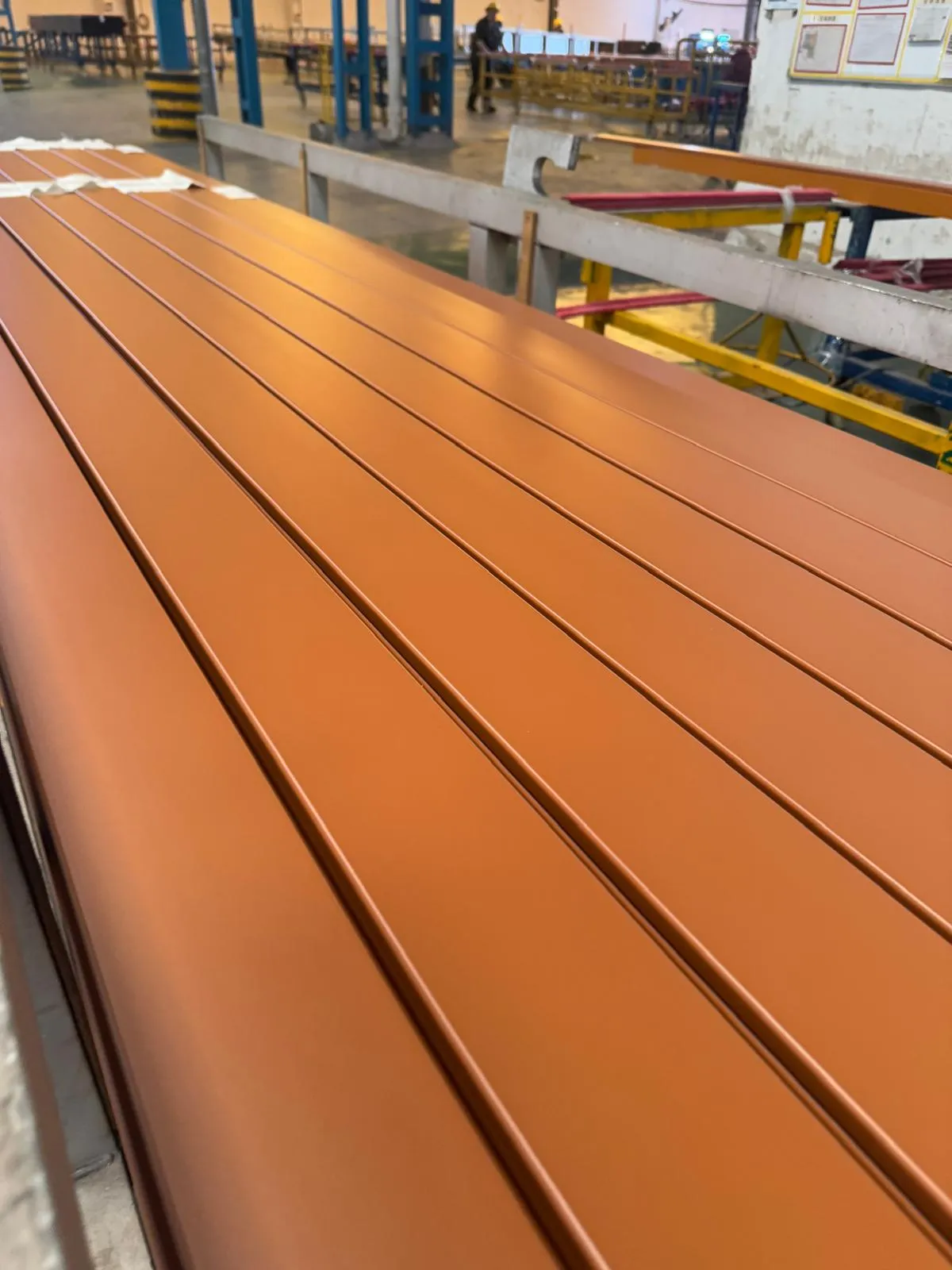
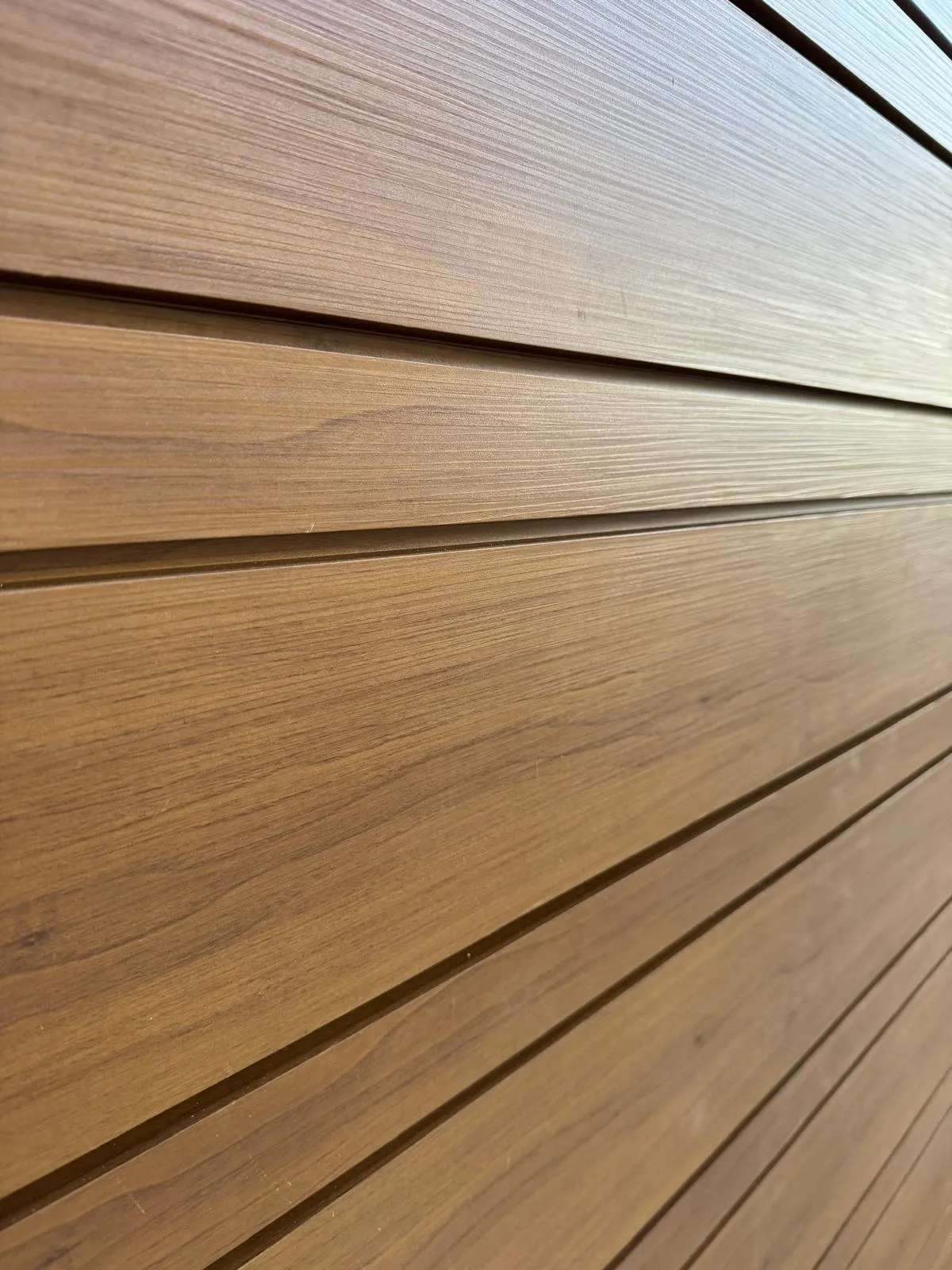
Hydrographic printing (also called water-transfer or immersion printing) is the budget alternative. A printed film floats on a water bath, the panel is dipped through it, and the ink wraps around the surface. The finish looks similar in catalog photos but performs poorly outdoors: hydrographic films sit on top of the substrate and can begin to lift at edges within 5 to 10 years of UV exposure.
Powder coat with wood-grain printing on the surface is the third approach. The wood imagery is screen-printed or pad-printed onto an already cured powder coat. Visually it can match sublimated finishes at year one. By year ten, the printed layer typically shows visible wear at high-touch areas (window trim, corner profiles) and uneven UV fading where the print sits on a slightly different chemistry than the underlying coat.
The performance gap between sublimation and the other two is real even before the powder-coat spec is decided — sublimation fuses the grain pattern into the cured coating where the other processes layer it on top. For projects with a 30 to 50 year facade horizon, pair sublimation with AAMA 2605 powder coat. For shorter horizons or refinish-tolerant projects, standard sublimation alone holds for roughly 5 to 10 years before requiring attention.
| Process | How it works | Outdoor lifespan | Best fit |
|---|---|---|---|
| Sublimation transfer | Ink vaporized into cured powder coat at ~200°C; grain bonded inside the polymer | 5 to 10 years | Architectural facades, residential rebuilds, premium specs |
| Hydrographic printing | Printed film floats on water bath; panel dipped through; ink wraps the surface | 5 to 10 years | Indoor or protected applications only |
| Surface printing on powder coat | Wood imagery screen-printed or pad-printed on top of cured powder coat | 10 to 15 years | Cost-driven projects, low-UV exposure |
What AAMA 2605 Means, and Why It’s the Spec That Matters
When an architect asks about finish durability on aluminum, the answer they’re looking for is whether the product meets AAMA 2605, the American Architectural Manufacturers Association’s highest-tier specification for organic coatings on aluminum extrusions and panels.
AAMA 2605 tests cover:
- Color retention under 10 years of South Florida exposure, measured by ASTM D2244 delta-E values within 5.0
- Chalk resistance under the same accelerated weathering protocol (ASTM D4214)
- Gloss retention at minimum 50% of original after 10 years
- Erosion resistance measured as film thickness loss
- Humidity, salt-spray, and chemical resistance for coastal and industrial environments
AAMA 2605 sits two tiers above AAMA 2603 (the minimum architectural finish) and one tier above AAMA 2604 (mid-grade). For coastal California, hot inland regions, or any specification subject to a 25-plus year facade warranty, 2605 is the only spec that doesn’t disappoint. Lower tiers are common in entry-level products and almost always fail visibly within 10 to 15 years.
Clicklad’s powder-coat program includes AAMA 2605-formulated finishes for projects that require long-finish life. The system documentation in /resources/ lists the substrate alloy (6063-T5/T6), the available coating tiers, and applicable test data so a specifier can drop the right spec into a 3-part spec without guessing.
Drafting a 3-part spec or comparing wood-grain options on a real project? Get in touch with our team and we’ll walk through the AAMA 2605 documentation, the available finish program, and the right system detail for your wall section.
Wood-Grain Aluminum vs Real Cedar: The Maintenance Math
The decision most homeowners and designers wrestle with isn’t aluminum versus vinyl. It’s aluminum versus the real thing. Cedar is beautiful. It also requires more attention than most homeowners budget for.
Per the Western Red Cedar Lumber Association, real cedar siding installed in a coastal California climate needs:
- Initial seal within 30 days of install (linseed oil, penetrating stain, or clear acrylic)
- Reseal cycle every 2 to 4 years depending on exposure
- Annual inspection for splits, cupping, insect damage, and fastener corrosion at the nail heads
- Spot repairs every 5 to 10 years (replacing planks that have rotted at end-grain joints)
- Full refinish every 10 to 15 years if any natural color is to be preserved
At professional rates, that work amortizes into a meaningful annual line item for a typical residential exterior, and a substantial cost-of-ownership delta across a 40-year horizon.
Wood-grain aluminum carries dramatically lower ongoing maintenance. An annual rinse with a garden hose is the entire upkeep program — the finish doesn’t oxidize, doesn’t grow mildew, and doesn’t develop nail-head bleed. The variable is the finish-refresh cycle: a standard sublimated finish holds its visual freshness for roughly 5 to 10 years, after which color and grain integrity will have faded enough that some owners choose to refinish the panel face. AAMA 2605 powder coats stretch that interval well beyond a decade. In either spec, there’s no annual sealing, no sanding, and no replacement of split planks.
The look at year one favors real cedar by a small margin. The look at year fifteen favors wood-grain aluminum, because the cedar has been refinished twice (probably unevenly), and individual planks have started to show splits at the ends. The aluminum substrate is still the same panel that came off the truck. The wood-grain finish — at year fifteen on an AAMA 2605 spec — looks essentially unchanged; on a standard sublimated spec, the panel is still structurally sound but a finish refresh is on the table.
The Color and Texture Palette
The early generation of wood-look aluminum (1980s and 1990s) offered three or four “wood tones” that were obvious paint jobs from across the street. Modern sublimated programs now cover the full real-wood palette:
- Light oak: pale golden with subtle vertical grain, the cedar-substitute most architects specify for coastal modern
- Walnut: deep brown with pronounced grain, popular on contemporary residential and Manhattan Beach craftsmans
- Cedar tone: warm red-brown that ages to a soft gray-brown after several years of sun, mimicking natural cedar weathering
- Teak: warm honey color with dense grain, common for soffit and ceiling applications
- Wenge: deep chocolate brown approaching near-black, with a tight straight grain, used on contemporary residential and Hollywood Hills projects where the design calls for a darker, more dramatic elevation
- Custom species: pattern matching to a homeowner’s existing cedar fence or interior flooring, often available on minimum order quantities
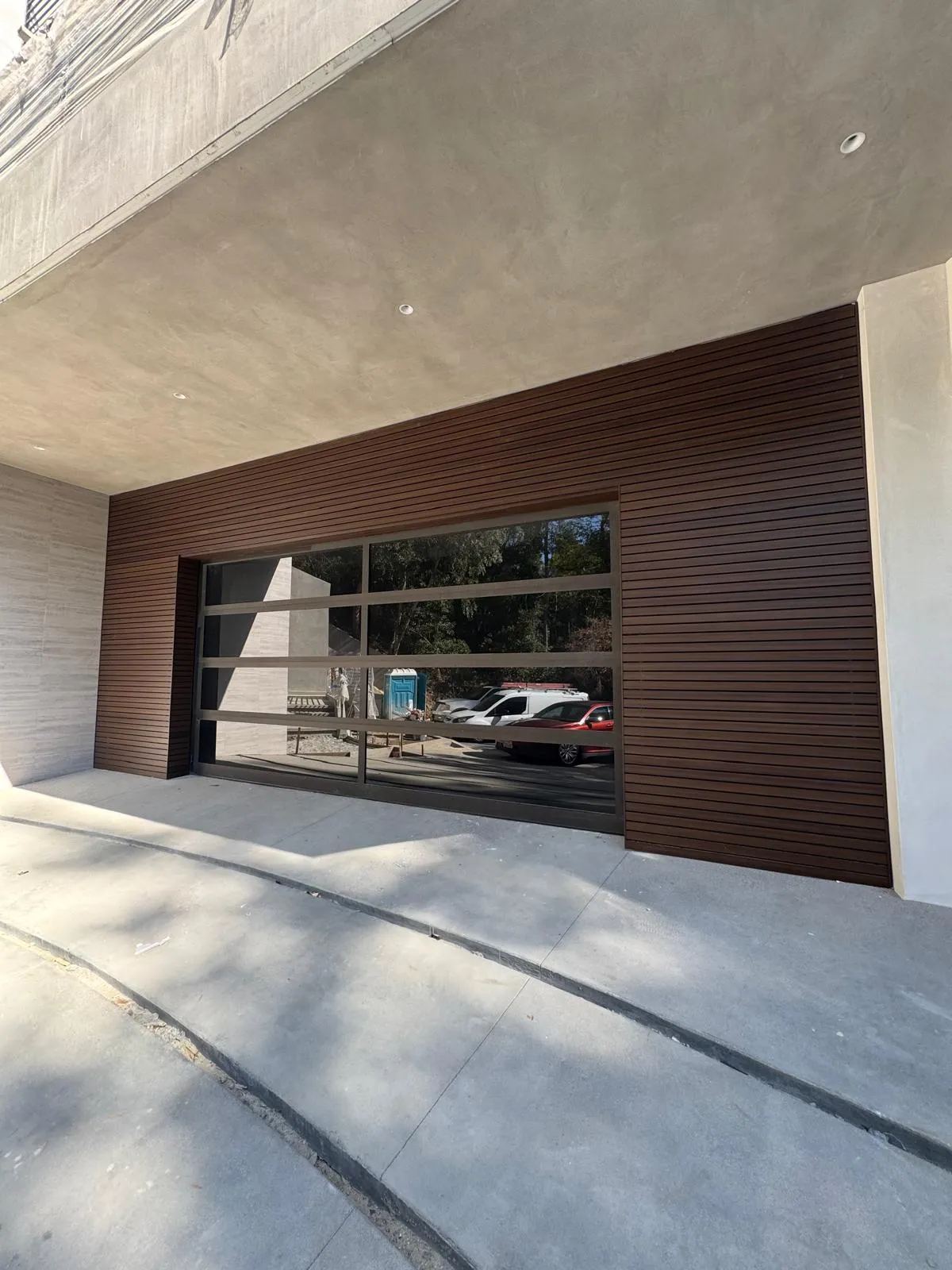
The grain pattern itself is more sophisticated than older products. Sublimation files used by premium manufacturers are scanned from actual wood boards, which means the grain doesn’t repeat across panels in the obvious way printed films do. A facade clad in 20 panels won’t show the visual rhythm that gives away a printed surface.
For texture, premium wood-grain aluminum is offered in both smooth and embossed finishes. Embossed adds physical texture to match the haptic of real wood when sunlight rakes across the facade at low angles. Smooth keeps the panel surface fully wipeable and is more common in commercial soffit and ceiling applications.
Where Wood-Grain Aluminum Earns Its Place
Not every project needs wood-grain. Where the look isn’t part of the design brief, a solid color powder coat is faster and cheaper. But for projects where the design specifically calls for warmth and natural materiality without the maintenance burden, the application map is wide:
- Residential facades and accent walls. The dominant use. Architects specify wood-grain aluminum for the same reason they once specified cedar: it humanizes a modern composition. Without the recoat cycle.
- Commercial soffits and ceilings. Wood-grain aluminum panels at the entry of a hotel, restaurant, or office building read as warm wood without the fire-code and maintenance complications real wood brings indoors.
- Sunshades, awnings, and trellises. Wood-grain aluminum panels show up under most pergola and shade structures specified in LA County since 2023, where the heat and UV would destroy a real-wood ceiling within a few seasons.
- Hospitality and multi-family interior accent walls. A wood-grain aluminum feature wall in a lobby or amenity space delivers the warmth a designer wants on a non-combustible substrate that satisfies commercial fire code.
- Wildland-urban interface (WUI) rebuilds. This is the highest-stakes case. Homeowners who lost cedar-clad homes in the 2025 Palisades and Eaton fires are rebuilding with wood-grain aluminum because it lets them recover the aesthetic they had while meeting CalFire’s Chapter 7A noncombustibility requirement. Real cedar is no longer code-compliant in those zones.
Each of these application types shows up across Clicklad’s project portfolio, and the relevant finish program can be matched to the specific use (smooth or embossed, light oak or walnut, residential or commercial scale).
The Bottom Line
Wood-grain aluminum sits in a small set of building products that genuinely earn the “looks like X, performs like Y” claim. Modern sublimation transfer combined with AAMA 2605 powder coats has closed the visual gap with real cedar to the point that the difference is invisible from the typical viewing distance on a residential or commercial facade. The maintenance gap is significant and runs in aluminum’s favor across the entire ownership horizon, with the finish-tier choice setting the refresh interval.
For a designer specifying warm, wood-toned exteriors on a fire-code-sensitive site, this is the material that doesn’t force a trade-off between the look and the long-term economics. For a homeowner rebuilding after a wildfire who wants the cedar elevation they had before, this is the material that lets them get it without violating the new code.
The current finish library and substrate options live on the products catalog.
Specifying wood-grain aluminum for an upcoming project? Talk to our team about finish options, color matching to your existing cedar reference, and how the system fits your wall section.
Frequently Asked Questions
How long does wood-grain aluminum siding actually last?
The aluminum substrate has a useful life of 40 to 50 years or longer. The wood-grain finish's outdoor life depends on the spec. A standard sublimated finish typically holds color and grain integrity for 5 to 10 years before noticeable UV fade. When the same panel is spec'd with AAMA 2605 powder coat, the finish life extends significantly — often the full life of the panel. Hydrographic or surface-printed finishes, regardless of substrate, sit in the same lower range and typically show wear by year 5 to 10.
Can wood-grain aluminum match the color of my existing cedar?
Yes, on most premium programs. Sublimation files can be matched to a piece of cedar or other wood the client provides as a reference, if the project meets the manufacturer's minimum order quantity. Custom matching usually requires a reference cutting from the source wood and four to eight weeks of lead time.
Does wood-grain aluminum siding work for fire-prone zones?
Yes. The aluminum substrate is non-combustible under ASTM E136 and qualifies for Class A under ASTM E84. The wood-grain finish doesn't compromise these ratings because the imagery is embedded in the powder-coat polymer rather than added as a separate combustible layer. Clicklad's wood-grain panels carry the same ICC-ES ESR-5054 and QAI CERUS-1051 ratings as solid-color panels, including approval for use in wildland-urban interface fire areas.
Is wood-grain aluminum more expensive than plain aluminum siding?
Yes, modestly. The sublimation step adds material and process cost to the manufacturing line, so wood-grain finishes carry a premium over equivalent solid-color powder-coat panels. The gap is typically smaller than the difference between any aluminum product and real cedar.
Can it be repaired if a panel gets damaged?
Individual panels can be replaced. The click-install system Clicklad uses makes single-panel replacement straightforward without disturbing adjacent panels. Color-matched replacement panels can be ordered from the same finish program, which is why specifiers should record the exact finish code at handover for any future repair.